Quotessence
Home / Quotes / Quote by Jiddu Krishnamurti

Quote by Jiddu Krishnamurti

“But there's a sacredness which is not of thought, nor of a feeling resuscitated by thought. It is not recognizable by thought nor can it be utilized by thought. Thought cannot formulate it. But there's a sacredness, untouched by any symbol or word. It is not communicable. It is a fact.”

Quote by Jiddu Krishnamurti

Work

Krishnamurtis Notebook

Browse quotes and source details for this work. more

Author
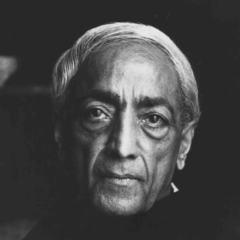
Jiddu Krishnamurti
Jiddu Krishnamurti

Jiddu Krishnamurti was an Indian philosopher, speaker, and writer who lived from May 12, 1895, to February 17, 1986. He is known for his teachings on the nature of the mind, consciousness, and the path to enlightenment. Krishnamurti emphasized the importance of self-inquiry and the transformation of consciousness, and his work has had a significant impact on individuals from various walks of life. more

You May Also Like

“When I did a therapist education in USA 1984, one of the course leaders – who had given personal and spiritual guidance to thousands of seekers of truth from all over the world, and who I consider to be one of the best spiritual therapists in the world – said that I was going to get enlightened, that I would ”disappear into the silence”. I did not really understand what he meant then, and it was totally absurd for me when other course participants congratulated me afterwards. The thought that I was going to be enlightened was totally absurd for me. For me enlightenment was something that happened to special and chosen persons like Osho, Buddha, Jesus, Lao-Tzu and Krishnamurti. I did not feel either special or chosen. I did not feel worthy of being enlightened.”

“And another question we are asking is: what is going to happen to humanity, to all of us, when the computer outthinks man in accuracy and rapidity—as the computer experts are saying it will? With the development of the robot, man will only have, perhaps, two hours of work a day. This may be going to happen within the foreseeable future. Then what will man do? Is he going to be absorbed in the field of entertainment? That is already taking place: sports are becoming more important; there is the watching of television; and there are the varieties of religious entertainment. Or is he going to turn inwardly, which is not an entertainment but something which demands great capacity of observation, examination and non-personal perception? These are the two possibilities. The basic content of our human consciousness is the pursuit of pleasure and the avoidance of fear. Is humanity increasingly going to follow entertainment? 21st July, 1981”