“Nothing is needed more than truth, and in relation to it everything else has only second-rate value." This unconditional will to truth—what is it? Is it the will not to allow oneself to be deceived? Or is it the will not to deceive? For the will to truth could be interpreted in the second way, too—if only the special case "I do not want to deceive myself" is subsumed under the generalization "I do not want to deceive." But why not deceive? But why not allow oneself to be deceived? Note that the reasons for the former principle belong to an altogether different realm from those for the second. One does not want to allow oneself to be deceived because one assumes that it is harmful, dangerous, calamitous to be deceived. In this sense, science would be a long-range prudence, a caution, a utility; but one could object in all fairness: How is that? Is wanting not to allow oneself to be deceived really less harmful, less dangerous, less calamitous? What do you know in advance of the character of existence to be able to decide whether the greater advantage is on the side of the unconditionally mistrustful or of the unconditionally trusting?”
Quote by Friedrich Nietzsche
Work
The Gay Science: With a Prelude in Rhymes and an Appendix of Songs
A seminal text that delves into the nature of science, ethics, and the human condition, featuring poetic prelude and musical appendices more
Author
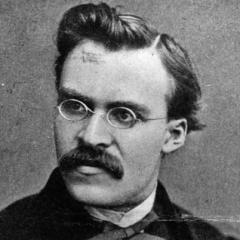
Friedrich Nietzsche
Friedrich Nietzsche was a German philosopher, cultural critic, poet, and writer whose works have had a profound impact on subsequent philosophy, literature, and thought. His ideas revolve around concepts such as the 'will to power', the 'Übermensch', and the 'eternal recurrence'. more
You May Also Like
Source: #Nerd
“Guys don’t talk about stuff like that. We just lie under the pile of bricks.”
Source: Beautiful Creatures
“I don’t need to love guys less; I need to love them more, with Christ’s love.”
Source: Nothing is here...
“If she tried to leave without him he would burn her house down, plain and simple.”
Source: Playing for Keeps
Source: Inescapable
Source: Real Secrets of Sex: A Women's Guide on How to Be Good in Bed