Quotessence
Home / Quotes / Quote by Joseph Conrad

Quote by Joseph Conrad

“They were dying slowly - it was very clear. They were not enemies, they were not criminals, they were nothing earthly now - nothing but black shadows of disease and starvation, lying confusedly in the greenish gloom. Brought from all the recesses of the coast in all the legality of time contracts, lost in uncongenial surroundings, fed on unfamiliar food, they sickened, became inefficient, and were then allowed to crawl away and rest.”

Quote by Joseph Conrad

Work

Heart of Darkness

Joseph Conrad's 'Heart of Darkness' is a seminal work that delves into the dark underbelly of colonialism and the psychological impact of exploration. The narrative follows Marlow, a seaman, as he navigates the treacherous Congo River and encounters the enigmatic Mr. Kurtz. more

Author

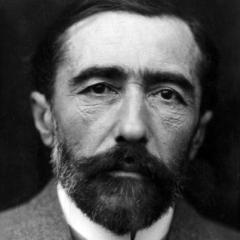
Joseph Conrad
Joseph Conrad

Joseph Conrad, born on December 3, 1857 in Poland and died on August 3, 1924 in the United Kingdom, was a renowned British author of the late 19th and early 20th centuries. He is known for his profound descriptions of maritime life and his insightful explorations of human nature. more

You May Also Like

“Shortly afterwards, it sounded as if the rocket-propelled grenades (RPGs) were landing dangerously close - so close that I immediately dropped to the floor, prompting an unflinching Congolese man in the lobby, who’d obviously endured much worse, to jokingly say, ”I see you do not enjoy the beautiful music we play here in the Congo.” It is still one of the most reassuring things anyone has ever said to me in the midst of a crisis….”

“War crimes, you say? No matter how many policies you put on paper, in reality, there are no rights and wrongs in war. War itself is a crime. War cannot be justified. I believe, the only people, in this world, whose opinions matter, are the ones who go the extra mile to help other people expecting nothing in return. Soldiers who fight fiercely for their country, the doctors in Sri Lanka's public hospitals attending to hundreds of patients at a time for no extra pay , the nuns who voluntarily teach English and math to children of refugee camps in the north, the monks who collect food to feed entire villages during crises, they are the people worth listening to, their opinion matters. So find me one of them who will say: they wish the war didn't end in 2009, that they wish Sri Lanka was divided into two parts. Find me one of them who agrees with the international war crime allegations against Sri Lanka, and I will listen. But I will not listen to the opinions of those who are paid to find faults in a war they were never a part of, a war they never experienced themselves. I will not listen to the opinions of those who watched the war on tv or read about it on the internet or were moved by a documentary on Al Jazeera. The war is over. The damage is done. Let Sri Lanka move on. So our children will never have to see what we've seen.”

“As to the efficacy of the policy recommended by Rostow, it speaks for itself: no country, once underdeveloped, ever managed to develop By Rostow's stages. Is that why Rostow is now trying to help the people of Vietnam, the Congo, the Dominican Republic, and other underdeveloped countries to overcome the empirical, theoretical, and policy shortcomings of his manifestly non-communist intellectual aid to economic development and cultural change by bombs, napalm, chemical and biological weapons, and military occupation?”

“Contrary to what most politicians and interveners preach, outside experts, national leaders, and top-down approaches are not the only means to reestablishing peace. Bottom-up initiatives can also make a difference, and ordinary people have the capacity to address some of the deeper roots of their country’s problems.”

“He [Stanley] had stated that he longed to do something wonderful for the African tribes along the Congo, and instead, as would become all too apparent, had set them up for a terrible fate. In 1877 he came down the great river as the first European ever to do so, declaring his hope that the Congo should become like `a torch to those who sought to do good'." Instead, it became the torch that attracted the archexploiter King Leopold II of Belgium.”

“Stanley must have realized that this postponement would probably be fatal. But while he did not give up, he never for a moment thought of abandoning his African quest [...] Yet Stanley still longed for the security of marriage, and hoped he could find Livingstone and marry Katie. [...] The romantic side of his nature told him that their story ought to end in marriage: the workhouse boy, having distinguished himself beyond all expectations, weds the daughter of the respectable local gentleman, and they live happily ever afterwards in a big house [...] But Katie had never understood his inner conviction of being chosen for a great task.”