Quotessence
Home / Quotes / Quote by George Orwell

Quote by George Orwell

“He thought with a kind of astonishment of the biological uselessness of pain and fear, the treachery of the human body which always freezes into inertia at exactly the moment when a special effort is needed. He might have silenced the dark-haired girl if only he had acted quickly enough; but precisely because of the extremity of danger he had lost the power to act. It struck him that in moments of crisis one is never fighting against an external enemy but always against one's own body. Even now, in spite of the gin, the dull ache in his belly made consecutive thought impossible. And it is the same, he percieved, in all seemingly heroic or tragic situatuions. On the battlefield, in the torture chamber, on a sinking ship, the issues that you are fighting for are always forgotten, because the body swells up until it fills the universe, and even when you are not paralyzed by fright or screaming with pain, life is a moment-to-moment struggle against hunger or cold or sleeplessness, against a sour stomach or an aching tooth.”

Quote by George Orwell

Book:1984

Work

1984

George Orwell's '1984' is a seminal work of literature that explores themes of government control, individuality, and the erosion of privacy. The story is set in a future where the world is divided into three superstates, each engaged in perpetual war. The protagonist, Winston Smith, works for the Ministry of Truth and is disillusioned with the oppressive regime. The novel delves into the psychological and societal consequences of living under constant surveillance and the struggle for truth and freedom. more

Author
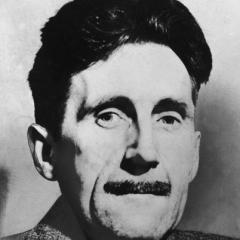
George Orwell
George Orwell

George Orwell, born Eric Arthur Blair, was a British novelist and political critic. Known for his sharp social criticism and profound insights into totalitarianism, Orwell is best remembered for his novels '1984' and 'Animal Farm', which remain influential to this day. more

You May Also Like

“[T]he relentless note of incipient hysteria, the invitation to panic, the ungrounded scenarios--the overwhelming and underlying desire for something truly terrible to happen so that you could have something really hot to talk about--was still startling. We call disasters unimaginable, but all we do is imagine such things. That, you could conclude mordantly, is the real soundtrack of our time: the amplification of the self-evident toward the creation of paralyzing, preëmptive paranoia.”

“My brothers’ faces haunt me. I hear their children, my nieces and nephews, asking me why I came home without their daddies. I think of their wives, imagine their questions. Our parents, forever seeing the faces of their lost sons when they look at me. They will want answers, demand to know how I survived. And what do I tell them? That I huddled like a baby inside my tent while their killer beckoned me forth for one last stand?”

“But a smell shivered him awake. It was a scent as old as the world. It was a hundred aromas of a thousand places. It was the tang of pine needles. It was the musk of sex. It was the muscular rot of mushrooms. It was the spice of oak. Meaty and redolent of soil and bark and herb. It was bats and husks and burrows and moss. It was solid and alive - so alive! And it was close. The vapors invaded Nicholas' nostrils and his hair rose to their roots. His eyes were as heavy as manhole covers, but he opened them. Through the dying calm inside him snaked a tremble of fear. The trees themselves seemed tense, waiting. The moonlight was a hard shell, sharp and ready to ready be struck and to ring like steel. A shadow moved. It poured like oil from between the tall trees and flowed across dark sandy dirt, lengthening into the middle of the ring. Trees seem to bend toward it, spellbound. A long, long shadow...”

“By nature independent, gay, even exuberant, seductively responsive and given to those spontaneous sallies that sparkle in the conversation of certain daughters of Paris who seem to have inhaled since childhood the pungent breath of the boulevards laden with the nightly laughter of audiences leaving theaters, Madame de Burne's five years of bondage had nonetheless endowed her with a singular timidity which mingled oddly with her youthful mettle, a great fear of saying too much, of going to far, along with a fierce yearning for emancipation and a firm resolve never again to compromise her freedom.”

“What would you think of an engineer who expounded the art of flying without revealing the secrets of the engine and propeller? That's what you do, you engineer of the human soul. Just that. You're a coward. You want the raisins out of my cake but you don't want the thorns of my roses. Haven't you too, little psychiatrist, been cracking silly jokes about me? Haven't you ridiculed me as "the prophet of bigger and better orgasms"? Have you never heard the whimpering of a young wife whose body has been desecrated by an impotent husband? Or the anguished cry of an adolescent bursting with unfulfilled love? Does your security still mean more to you than your patient? How long will you go on valuing your respectability above your medical mission? How long will you refuse to see that your pussyfooting procrastination is costing millions their lives?”