Quotessence
Home / Quotes / Quote by Tom Robbins

Quote by Tom Robbins

Work

Fierce Invalids Home From Hot Climates

The title presents a striking combination of contrasting concepts. The word fierce indicates sharpness of will or intensity of spirit, while invalids suggests persons affected by illness or physical weakness. The phrase home from hot climates implies a journey undertaken to warmer territories and subsequent return, potentially alluding to historical practices of seeking healing in tropical environments. The title's poetic construction suggests metaphorical rather than literal meaning, with the juxtaposition of fierce determination against physical frailty creating a memorable and symbolic phrasing. The language hints at questions of health, place, and identity without specifying particular characters, settings, or narrative events. more

Author
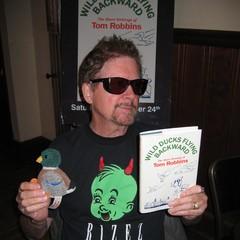
Tom Robbins
Tom Robbins

Tom Robbins (born July 22, 1936) is an acclaimed American novelist known for his whimsical, philosophical, and often surreal storytelling. His works blend pop culture, Eastern spirituality, and countercultural themes, with notable titles including 'Another Roadside Attraction' and 'Even Cowgirls Get the Blues'. Born in North Carolina, Robbins worked as a journalist and art critic before turning to fiction. His novels are celebrated for their linguistic playfulness, eccentric characters, and profound meditations on love, freedom, and the human condition. Though not a recipient of major literary prizes, he has cultivated a devoted global readership and influenced generations of writers. He remains a distinctive voice in contemporary American literature. more

You May Also Like

“It would seem that the intellectual titans of the Enlightenment had no inkling of what was getting under way. Yet, strangely, all around the earth, ordinary people seem to have sensed the stirring of something momentous. They seemed to have understood that a process had been launched that could lead ultimately to catastrophe: what they didn't allow for was that the story might take a few hundred years to play out. It has fallen to us, centuries later, to bear witness to the last turn of the wheel. And what we are seeing already -' he paused to point a finger in the direction of the distant wildfires - 'should be enough to remind us that the climatic perturbations of the Little Ice Age were trivial compared to what is in store for us now. What our ancestors experienced is but a pale foreshadowing of what the future holds!”

“Couldn't it be said that it was in the seventeenth century that we started down the path that has brought us to where we are now? After all, it was then that Londoners began to use coal on a large scale, for heating, which was how our dependence on fossil fuels started. Would your Jacobean playwrights have written as they did if they hadn't had coal fires to warm them? Did they know that an angry beast, which had long lain dormant within the earth, was coming to life? Did Hobbes or Leibniz or any of the other thinkers of the Enlightenment have any understanding of this?”

“Quiero señalar otra cuestión importante sobre las 29.404 muertes del año 2013. El clima ya no es una de las principales causas de mortalidad, gracias sobre todo a los combustibles fósiles. En cambio, todavía hay mil trescientos millones de personas que viven sin electricidad y una gran mayoría de ellas sufrirán una muerte prematura, un problema que sólo podría resolverse usando más combustibles fósiles. No sólo estamos ignorando la cuestión de conjunto cuando convertimos el cambio climático en la obsesión de nuestra cultura, sino además nos hemos propuesto «combatir» ese cambio climático rechazando el arma que ha reducido su peligrosidad de manera espectacular. (...) No hemos recibido un clima seguro y lo hemos transformado en algo peligroso; hemos recibido un clima peligroso y lo hemos convertido en mucho más seguro. La civilización de la energía, y no la metereología, es el eje impulsor de la habitabilidad climática. Pase lo que pase, el clima siempre será peligroso por su propia naturaleza, y la pregunta clave siempre será si poseemos la capacidad de lidiar con él o, mejor aún, si somos capaces de dominarlo.”

“[...] obtenir la baisse de notre dépendance aux combustibles fossiles demande de la méthode et de la gestion, et non une croyance aveugle dans des objets techniques particuliers qui seraient nécessairement adaptés partout et tout le temps.”

“[I]f I can be sure of any aspect of your character, it is that you are not as I. Since all I can do here is imagine you in my image, of course I have failed. I was as fossil fuels made me. They kept my lights on. Hence I who imagine myself to be open-minded will appear to you as deservedly dead, fossilized in the stratum of my own period’s prejudices.”