Quotessence
Home / Quotes / Quote by George Bernard Shaw

Quote by George Bernard Shaw

Work

Author

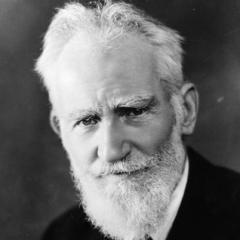
George Bernard Shaw
George Bernard Shaw

George Bernard Shaw (July 26, 1856 - November 2, 1950) was an Irish-British playwright, critic, and socialist. He is renowned for his satirical and witty dramatic works. more

You May Also Like

“I believe in strong women. I believe in the woman who is able to stand up for herself. I believe in the woman who doesn't need to hide behind her husband's back. I believe that if you have problems, as a woman you deal with them, you don't play victim, you don't make yourself look pitiful, you don't point fingers. You stand and you deal. You face the world with a head held high and you carry the universe in your heart.”

“Underlying phenomena such as the ‘feminisation’, ‘masculinisation’ and ‘juvenilisation’ of poverty, and other identity ways to describe segments of the poverty population such as the poverty of the elderly, or the ‘feminisation of the proletariat’, the ‘feminisation of migration’, or the disproportionate poverty of racial and ethnic minorities, is the impoverishment the working class, the deterioration in the working class’s standard of living and family stability. Consequently, while policies targeted at different poverty populations are important to help and improve the lives of those who are already poor, it must also be recognised that poverty is not uniquely a women’s issue, or a men’s issue, and so forth: poverty is a class issue which can, at best, be ameliorated – not resolved because it is endemic to the capitalist mode of production – through labour’s collective action, through unionisation and struggles for job training and job creation aimed at creating employment for manual, skilled and unskilled labour, in addition to programmes intended to enhance the health and educational opportunities for everyone, regardless of gender, race or ethnicity.”

“This is why people are chasing their aces all over the poorest bays. Not because they've some genuine belief that they will catch the card. They can barely catch a break at all. A century of impoverishment and industry collapse, pillaging and recrimination, has taught them not to hope for much but a bit of fun when the cards are cut.”

“Let us just say that the idea of struggling to make my way in a world of privileged, affluent people exhausted me before I even tried: I was the child of nothing, I had neither beauty not charm, neither past nor ambition; I had not the slightest savoir-fare or sparkle. There was only one thing I wanted: to be left alone, without too many demands upon my person, so that for a few moments each day I might be allowed to assuage my hunger.”