Quotessence
Home / Quotes / Quote by Vasily Grossman

Quote by Vasily Grossman

“Communication between people of different nationalities enriches human society and makes it more colourful.. Imagine our Russian intellectuals, the kind, merry, perceptive old women in our villages, our elderly workers, our young lads, our little girls being free to enter the melting pot of ordinary human intercourse with the people of North and South America, of China, France, India, Britain and the Congo. What a rich variety of customs, fashion, cuisine and labour would then be revealed! what a wonderful human community would then come into being, emerging out of so many peculiarities of national characters and ways of life. And the beggarliness, blindness and inhumanity of narrow nationalism and hostility between states would be clearly demonstrated.”

Quote by Vasily Grossman

Work

An Armenian Sketchbook

Browse quotes and source details for this work. more

Author
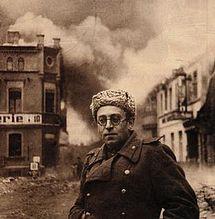
Vasily Grossman
Vasily Grossman

Vasily Grossman (December 12, 1905 – September 14, 1964) was a Soviet Jewish writer and journalist, best known for his works on World War II. Born in Berdychiv, Ukraine, he initially studied chemical engineering before turning to literature. As a war correspondent for the Red Star newspaper, he witnessed the Battle of Stalingrad and documented Nazi atrocities. His masterpiece, Life and Fate, was banned by Soviet authorities for its criticism of Stalinism and only published in the 1980s. Grossman's works explore themes of war, totalitarianism, and humanity, earning him recognition as a significant voice in 20th-century Russian literature. more

You May Also Like

“We can view politics as an art form, since political action shapes human beings destiny to be an ambassador of goodwill and humanitarian activities. Alternatively, we can perceive politics as a crime because it can give vent to collective passions of hatred and barbarism. Americans must decide whether to muster our collective political powers to end warfare and curb corporate exploitation of natural resources or pursue nationalism and perpetuate barbarous ruination of the environment. The outcome of these decisive challenges will alter our national consciousness.”

“Deutsche Charaktere. Das ist die schon hundertmal hergeleierte Klage der allgemeinen Bibliothek, über der einem fast alle Gedult ausgehen mögte. Ich frage gleich: Was ist ein deutscher Charakter? Was? Nicht wahr, Tabakrauchen und Ehrlichkeit? O Ihr einfältigen Tröpfe. Hört seid so gut und sagt mir, was ist es für Wetter in Amerika? Soll ichs statt eurer sagen? Gut. Es blitzt, es hagelt, es ist dreckig, es ist schwül, es ist nicht auszustehn, es schneit, friert, wehet und die Sonne scheint.”

“I do believe in the existence of something which may roughly be named "national character." It must not, however, be misunderstood in a naturalistic sense. It belongs to the socio-cultural, not to the biological sphere. National character may be identified with the specific "way of life," with the complex of cultural values, patterns of behaviour, and system of institutions which are peculiar to each country. The national character is formed historically, and it is possible to determine the factors that have entered into its make-up. Once crystallized, it is likely to show considerable stability and an ability to reject, or assimilate, disruptive influences. Of great importance is the fact that a national character, or cultural type, is not something unique and original, but rather an individual combination of traits which are widespread through the world, and common to a number of peoples.”

“Yet here he has consciously denied the Parliament of Scotland a familiar consumable image. When a lesser architect with a less wise client could have contrived a form, an image that could have popularised the project and the mission of government (playing with the stereotypes of Scottish history and charcater), Miralles has given a form to Parliament devoid of symbols (at least easily recognised symbols), devoid of answers or illusions, its form representing nothing but its own nature... ...the Parliament seems to be an object outside of history, a place speaking only of the circumstances of its own nature and use... the architect of the Scottish Parliament has created an object promising nothing but itself. At this time and place in Scottish history and to a public wary of the easy promises of politicians, it is too early to say anything. ...what the Parliament will symbolise will be formed in the events of the history it makes, formed and reformed over the centuries in response to the laws made within it and its relation to the changing idea of Scotland. It is not shaped to be loved, to be immediately attractive, to make promises it cannot keep, to toy with vulgar myths or to play with representations of history or culture, and it may never be comfortable.”