Quotessence
Home / Authors / Annette Bening Books
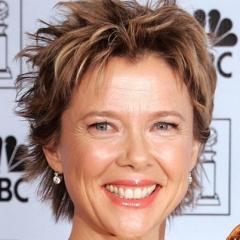
Annette Bening

Annette Bening Books

Actress

No books found for this author.

Related Quotes

“I'm just as intrigued by acting as ever. It's an ongoing process. There's no arrival. There's no point at which you say "Oh, OK, done it, got it." It just doesn't happen. And that's true of any creative endeavor. For me, it's just a lifelong interest. I'm very much interested in the craft. I started by doing plays and it took me a long time to feel comfortable doing movies, working with cameras. I felt like I was a theater actress pretending that I was a movie actress for quite a while. Now, I just love the process of working with cameras and being on a set and trying to put a film together.”

“One of the things on a very practical level as an actor or actress is that when you do a play, you do the entire story every time you do it. You have eight shows a week. You have a rehearsal process of four to five to six weeks. And then once you're in performance, everybody else goes away and you're there with your fellow actors and the audience and the material and your life becomes about that. And you go through the story from the beginning to the end every time you do it and depending on how long you do it, that's where the craft comes in.”

“Modern acting is method acting, most of it. And there are sort of different schools, so I guess I'm not really from one school or another. I had a number of different teachers but they were all kind of drawing from the same pool, which is - What do you want? What are you doing to get what you want? And, what is in the way? These are basic acting questions. Knowing the answers to those questions. So you're talking about objectives and actions and obstacles. That's a sort of shorthand that gives you a language.”

“A lot of acting is working with your own psyche in order to allow yourself to be open and reveal yourself. But then of course there's a healthy part of you that says, "Well, don't do that." You know, you're going to be in front of people. You could look foolish. You could get it wrong. You could be too big or too small or not realistic or whatever those things are. People might criticize you. There's all kinds of reasons not to be open. But you do want to be open.”

“You have to learn to deal with your own, for want of a better word, insecurities, fears. They don't go away. And that's normal. It's human. You don't ever really want to lose that. What you want to do is learn to manage it and to work with yourself. But there's a part of you that has anticipation and fear. And so the important thing to know is that there's nothing wrong with that and that that's normal. You have to learn how to deal with it, certainly, but it doesn't keep you from doing it. And that doesn't go away ever.”

“It's always tricky to watch yourself, always. When I first had to watch myself, it was really hard because I'd done quite a few plays and I've never seen myself. So I was professional but I'd never watched myself. So I was like hearing you know... I'm sure you guys are all much more familiar with that because everybody has a phone, and everyone's taking pictures of themselves and making movies of themselves. And so people are more accustomed to it now. So I had to get used to it because there's a lot to be learned, of course, as an actor. When you watch yourself, you learn a lot.”

“Of course, you can never watch something like somebody else watches something like you, but nonetheless, you have to try. So I think on camera you learn a lot about how much the camera does for you, which is what is the great luxury of movie acting. Or acting whether it's TV or movies or whatever it is, that the camera's really such a gift because there's so much that it sees and does if you're willing to just be open and expose yourself and all of that. So you also learn what doesn't matter. And sometimes when you think about things, you think things matter that don't matter.”

“Sometimes people don't rehearse at all, but you might have had a chance to rehearse for a few days, or even more than that. Then in the moment when the camera's running is the only time it matters. So whatever you've discussed or thought about or discussed with the director, the other actors, hopefully there's a part of the experience that you've left open so that only in that moment the camera catches it. That's of course the hardest thing to do because everything is planned and you have thought about it in advance.”

“Once I get on something, once I have something that I'm working on, then I become very obsessive. In a good way. I mean,... is there a positive way to say obsessive? It's a good thing and if you're out there and you're working on something right now and you're crazed and you're up in the middle of the night, or you can't stop thinking about it, or you have to keep reading other things about the subject that you're working on or whatever. That's good and I think that's necessary creatively.”

“People always ask us women about how we balance our lives. Rarely do they ever ask men this but we are asked this and it makes a lot of sense - balance, right? It sounds right. And of course you do have to balance because otherwise you'd go crazy. And you do have to find ways of doing things in a sensible manner, raising children and all those choices. But then there's a part of creativity which is irrational and which is obsessive and then that's also part of what we do. So, I don't think that's a bad thing. I think that's part of what makes someone good.”

“Most of the people that I've worked with when shooting films that I really respect, there is a point which you do become obsessed in a good way. And because it's a collaborative medium, you're not by yourself in a room tearing your hair out, you're in a room with a bunch of people. And we're all tearing our hairs out, or trying to get something right, or caring deeply about something. But that's fun.”

“This is a good thing to say to film students. If there's a story point that you don't feel right about, that there's a question you have - "Does it really make sense?" Or, "Is that plausible? Is it implausible? Is it set up?" Or whatever. Go at it. Don't let it go. If there's a question in your mind, you're probably right. You probably do need to work on it and think about it more.”

“If you push in every time there's a big moment, then the tenth time you push in, you're not going to get the same effect. Or if you have too many close ups, then when you have a big moment and you want a close-up in order to make a point, it doesn't mean anything because you've already been doing close-ups. It's like writing in all capitals. Then after a while that doesn't mean anything. So, just because you can do something with a camera doesn't mean you should.”

“One of the things that I love when I go to a film or when I'm reading some book or whatever, is to be told a secret I thought only I knew and then someone says, "Oh my gosh, you know, too." And film can take us into private moments in a way that the theater, I think, kind of can't, and that's one of the reasons I like doing films. And the way a book can is that these little secrets and the private things that go on in our minds that maybe we haven't shared with anyone, and then someone writes it or shows it to you in a film, you think, "Oh, that's me. Oh my God, that's me, I have that secret."”

“You can't ask the guy with the checkbook to always be the person. So, we actors have to try. And believe me, it's not just young people who are struggling with this, trying to get things of substance made because of the proliferation of technology that it's just harder and harder to get things that really matter made. But they are being done and you just have to fight the good fight and try to... if you have something that you have written, you have to do your best to try to get it made in whatever way you can.”

“I think where I've instinctively found myself is that I am somewhat guarded in my public life. Being interviewed or being photographed or just in public attention, I have a certain reserve. But when I'm working I feel like I'm very open. At least I like to believe that I feel like nothing is held back when I'm in front of a camera. That's my job.”