Quotessence
Home / Authors / E. M. Forster
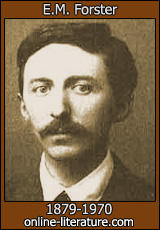
E. M. Forster

E. M. Forster Quotes

Novelist

Filter quotes by topic

Famous E. M. Forster Quotes

“Italy is such a delightful place to live in if you happen to be a man. There one may enjoy that exquisite luxury of Socialism--that true Socialism which is based not on equality of income or character, but on the equality of manners. In the democracy of the caffè or the street the great question of our life has been solved, and the brotherhood of man is a reality. But it is accomplished at the expense of the sisterhood of women.”

“Some leave our life with tears, others with an insane frigidity; Mrs. Wilcox had taken the middle course, which only rarer natures can pursue. She had kept proportion. She had told a little of her grim secret to her friends, but not too much; she had shut up her heart--almost, but not entirely. It is thus, if there is any rule, that we ought to die--neither as victim nor as fanatic, but as the seafarer who can greet with an equal eye the deep that he is entering, and the shore that he must leave.”

“Was Mrs. Wilcox one of the unsatisfactory people- there are many of them- who dangle intimacy and then withdraw it? They evoke our interests and affections, and keep the life of the spirit dawdling around them. Then they withdraw. When physical passion is involved, there is a definite name for such behaviour- flirting- and if carried far enough, it is punishable by law. But no law- not public opinion, even- punishes those who coquette with friendship, though the dull ache that they inflict, the sense of misdirected effort and exhaustion, may be as intolerable. Was she one of these?”

“I can only do what's easy. I can only entice and be enticed. I can't, and won't, attempt difficult relations. If I marry it will either be a man who's strong enough to boss me or whom I'm strong enough to boss. So I shan't ever marry, for there aren't such men. And Heaven help any one whom I do marry, for I shall certainly run away from him before you can say 'Jack Robinson.”

“It was not that ladies were inferior to men; it was that they were different. Their mission was to inspire others to achievement rather than to achieve themselves. Indirectly, by means of tact and a spotless name, a lady could accomplish much. But if she rushed into the fray herself she would be first censured, then despised, and finally ignored.”

“For a wonderful physical tie binds the parents to the children; and - by some sad, strange irony - it does not bind us children to our parents. For if it did, if we could answer their love not with gratitude but with equal love, life would lose much of its pathos and much of its squalor, and we might be wonderfully happy.”

“What is the good of your stars and trees, your sunrise and the wind, if they do not enter into our daily lives? They have never entered into mine, but into yours, we thought--Haven't we all to struggle against life's daily greyness, against pettiness, against mechanical cheerfulness, against suspicion? I struggle by remembering my friends; others I have known by remembering some place--some beloved place or tree--we thought you one of these.”

“A novelist can shift view-point if it comes off. ... Indeed, this power to expand and contract perception (of which the shifting view-point is a symptom), this right to intermittent knowledge - I find one of the great advantages of the novel-form ... this intermittence lends in the long run variety and colour to the experiences we receive.”

“The test of a round character is whether it is capable of surprising in a convincing way. If it never surprises it is flat. Flat characters ... in their purest form ... are constructed round a single idea or quality; when there is more than one factor to them, we get the beginning of the curve toward the round. The really flat character can be experessed in one sentence such as, "I will never desert Mr Micawber." There is Mrs Micawber - she says she won't desert Mr Micawber; she doesn't, and there she is.”

“Neanderthal man listened to stories, if one may judge by the shape of his skull. The primitive audience was an audience of shock-heads, gaping around the camp-fire, fatigued with contending against the mammoth or wooly-rhinoceros, and only kept awake by suspense. What would happen next? The novelist droned on, and as soon as the audience guessed what happened next, they either fell asleep or killed him.”

“If human nature does alter it will be because individuals manage to look at themselves in a new way. Here and there people - a very few people, but a few novelists are among them - are trying to do this. Every institution and vested interest in against such a search: organized religion, the state, the family in its economic aspect, have nothing to gain, and it is only when outward prohibitions weaken that it can proceed: history conditions it to that extent.”