Quotessence
Home / Authors / Nadia Bolz-Weber Biography
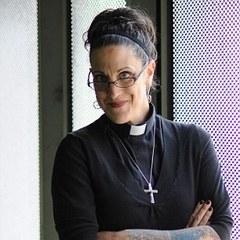
Nadia Bolz-Weber

Nadia Bolz-Weber Biography

Pastor

Related Quotes

“Seeing myself or my church or my denomination as "the blessing" — like so many mission trips to help "those less fortunate than ourselves" — can easily descend into a blend of  benevolence and paternalism. We can start to see the "poor" as supporting characters in a big story about how noble, selfless, and helpful we are.”

“God's grace is not defined as God being forgiving to us even though we sin. Grace is when God is a source of wholeness, which makes up for my failings. My failings hurt me and others and even the planet, and God's grace to me is that my brokenness is not the final word ... it's that God makes beautiful things out of even my own shit. Grace isn't about God creating humans and flawed beings and then acting all hurt when we inevitably fail and then stepping in like the hero to grant us grace - like saying, "Oh, it's OK, I'll be the good guy and forgive you." It's God saying, "I love the world too much to let your sin define you and be the final word. I am a God who makes all things new.”

“Personally, I think knowing the difference between a racist and a saint is kind of  important. But when Jesus again and again says things like the last shall be first, and the first shall be last, and the poor are blessed, and the rich are cursed, and that prostitutes make great dinner guests, it makes me wonder if our need for pure black-and-white categories is not true religion but maybe actually a sin. Knowing what category to place hemlock in might help us know whether it's safe to drink, but knowing what category to place ourselves and others in does not help us know God in the way that the church so often has tried to convince us it does.”

“If the quality of my Christianity lies in my ability to be more inclusive than the next pastor, things get tricky because I will always, always encounter people—intersex people, Republicans, criminals, Ann Coulter, etc.—whom I don't want in the tent with me. Always. I only really want to be inclusive of some kinds of people and not of others.”

“Of course, Mary Magdalene would have very little tolerance for the Christian platitudes and vapid optimism that seem to swirl around these kinds of tragic events. Those platitudes are tempting, but they're nothing but luxuries for people who've never had demons (or at least have never admitted to them). But equally, she would reject nihilism, or the idea that there is no real meaning in life or death - ideas present in so much of postmodernity. Those ideas, too, are luxuries, but they are for those who have never been freed from demons.”

“Jesus says, "Deny yourself, take up your cross and follow me." He says, "The first shall be last and the last shall be first," and infuriating things like "if you seek to find your life you will lose it but those who lose their life will find it." And every single time I die to something—my notions of my own specialness, my plans and desires for something to be a very particular way—every single time I fight it and yet every single time I discover more life and more freedom than if I had gotten what I wanted.”

“My former bishop Allan Bjorberg once said that the greatest spiritual practice isn't yoga or praying the hours or living in intentional poverty, although these are all beautiful in their own way. The greatest spiritual practice is just showing up. And Mary Magdalene is the patron saint of just showing up. Showing up, to me, means being present to what is real, what is actually happening. Mary Magdalene didn't necessarily know what to say or what to do or even what to think when she encountered the risen Jesus. But none of that was nearly as important as the fact that she was present and attentive to him.”

“While we as people of  God are certainly called to feed the hungry and clothe the naked, that whole "we're blessed to be a blessing" thing can still be kind of dangerous. It can be dangerous when we self-importantly place ourselves above the world, waiting to descend on those below so we can be the "blessing" they've been waiting for, like it or not.”

“We often behave as though Jesus is only interested in saving and loving a romanticized version of ourselves, or an idealized version of our mess of a world, and so we offer to him a version of our best selves. With our Sunday school shoes on, we sing songs about kings and drummers at his birth, perhaps so we can escape the Herod in ourselves and in the world around us. But we've lost the plot if we use religion as the place where we escape from difficult realities instead of as the place where those difficult realities are given meaning.”

“As a teenager, I began to question the Great Christian Sorting System. My gay friends in high school were kind and funny and loved me, so I suspected that my church had placed them in the wrong category... Injustices in the world needed to be addressed and not ignored. Christians weren't good; people who fought for peace and justice were good. I had been lied to, and in my anger at being lied to about the containers, I left the church. But it turns out, I hadn't actually escaped the sorting system. I had just changed the labels.”

“It happens to all of us, I concluded that Easter Sunday morning. God simply keeps reaching down into the dirt of humanity and resurrecting us from the graves we dig for ourselves through our violence, our lies, our selfishness, our arrogance, and our addictions. And God keeps loving us back to life over and over.”