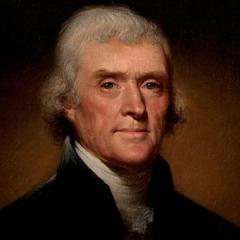
“It will be said that great societies cannot exist without government.”
Source: The writings of Thomas Jefferson
“It is a problem, not clear in my mind, that [a society without government, as among our Indians] is not the best. But I believe it to be inconsistent with any great degree of population.”
Source: The portable Thomas Jefferson
“The excellence of every government is its adaptation to the state of those to be governed by it.”
Source: The writings of Thomas Jefferson: being his autobiography, correspondence, reports, messages, addresses, and other writings, official and private : published by the order of the Joint Committee of Congress on the Library, from the original manuscripts, deposited in the Department of State
“Every society has a right to fix the fundamental principles of its association, and to say to all individuals, that if they contemplate pursuits beyond the limits of these principles and involving dangers which the society chooses to avoid, they must go somewhere else for their exercise; that we want no citizens, and still less ephemeral and pseudo-citizens, on such terms. We may exclude them from our territory, as we do persons infected with disease.”
Source: Memoirs, Correspondence, and Private Papers of Thomas Jefferson: Late President of the United States
“Every people may establish what form of government they please, and change it as they please, the will of the nation being the only thing essential.”
Source: Memoirs, Correspondence and Private Papers of Thomas Jefferson, Late President of the United States
“The provisions we have made [for our government] are such as please ourselves; they answer the substantial purposes of government and of justice, and other purposes than these should not be answered.”
“The right of self-government does not comprehend the government of others.”
Source: The Writings of Thomas Jefferson: Correspondence, cont
“To constrain the brute force of the people, the European governments deem it necessary to keep them down by hard labor, poverty and ignorance, and to take from them, as from bees, so much of their earnings, as that unremitting labor shall be necessary to obtain a sufficient surplus to sustain a scanty and miserable life.”
Source: Memoir, Correspondence, and Miscellanies: From the Papers of Thomas Jefferson
“Government as well as religion has furnished its schisms, its persecutions and its devices for fattening idleness on the earnings of the people.”
Source: The Papers of Thomas Jefferson: 1 October 1814 to 31 August 1815
“Anarchy [is] necessarily consequent to inefficiency.”
“We are now vibrating between too much and too little government, and the pendulum will rest finally in the middle.”
Source: The Works of Thomas Jefferson: Correspondence 1786-1787
“We exist, and are quoted, as standing proofs that a government, so modeled as to rest continually on the will of the whole society, is a practicable government.”
Source: Light and Liberty: Reflections on the Pursuit of Happiness
“A noiseless course, not meddling with the affairs of others, unattractive of notice, is a mark that society is going on in happiness. If we can prevent the government from wasting the labors of the people under the pretense of taking care of them, they must become happy.”
Source: The writings of Thomas Jefferson: being his autobiography, correspondence, reports, messages, addresses, and other writings, official and private
“I hope that we have not labored in vain, and that our experiment will still prove that men can be governed by reason.”
Source: The Writings of Thomas Jefferson: Correspondence
“Truth and reason are eternal. They have prevailed. And they will eternally prevail; however, in times and places they may be overborne for a while by violence, military, civil, or ecclesiastical.”
Source: Thomas Jefferson: A Chronology of His Thoughts
“Truth will do well enough if left to shift for herself. She seldom has received much aid from the power of great men to whom she is rarely known and seldom welcome. She has no need of force to procure entrance into the minds of men.”
Source: Light and Liberty: Reflections on the Pursuit of Happiness
“Everyone must act according to the dictates of his own reason.”
“I have so much confidence in the good sense of man, and his qualifications for self-government, that I am never afraid of the issue where reason is left free to exert her force.”
Source: Thomas Jefferson: A Chronology of His Thoughts
“Ignorance and bigotry, like other insanities, are incapable of self-government.”
Source: Memoir, correspondence, and miscellanies from the papers of T. Jefferson
“Every man's reason is his own rightful umpire. This principle, with that of acquiescence in the will of the majority, will preserve us free and prosperous as long as they are sacredly observed.”
Source: The writings of Thomas Jefferson: being his autobiography, correspondence, reports, messages, addresses, and other writings, official and private : published by the order of the Joint Committee of Congress on the Library, from the original manuscripts, deposited in the Department of State
“I hold it certain that to open the doors of truth and to fortify the habit of testing everything by reason are the most effectual manacles we can rivet on the hands of our successors to prevent their manacling the people with their own consent.”
Source: Jefferson: Political Writings
“If virtuous, the government need not fear the fair operation of attack and defense. Nature has given to man no other means of sifting the truth, either in religion, law, or politics.”
Source: Thomas Jefferson: A Chronology of His Thoughts
“I am not myself apt to be alarmed at innovations recommended by reason. That dread belongs to those whose interests or prejudices shrink from the advance of truth and science.”
Source: The Papers of Thomas Jefferson, Retirement Series, Volume 7: 28 November 1813 to 30 September 1814
“Where thought is free in its range, we need never fear to hazard what is good in itself.”
Source: The Writings of Thomas Jefferson: Correspondence
“Difference of opinion leads to enquiry, and enquiry to truth; and I am sure...we both value too much the freedom of opinion sanctioned by our Constitution, not to cherish its exercise even where in opposition to ourselves.”
“The opinions of men are not the object of civil government, nor under its jurisdiction.”
Source: The Essential Jefferson
“We ought not to schismatize on either men or measures. Principles alone can justify that.”
Source: The Works of Thomas Jefferson: Correspondence and Papers, 1808-1816
“I see the necessity of sacrificing our opinions sometimes to the opinions of others for the sake of harmony.”
Source: The Papers of Thomas Jefferson
“He alone who walks strict and upright, and who, in matters of opinion, will be contented that others should be as free as himself and acquiesce when his opinion is freely overruled, will attain his object in the end.”
“With the same honest views, the most honest men often form different conclusions.”
Source: Thomas Jefferson: Thoughts on War and Revolution
“A government held together by the bands of reason only, requires much compromise of opinion.”
Source: Correspondence. Reports and opinions while secretarry of state
“Nothing but good can result from an exchange of information and opinions between those whose circumstances and morals admit no doubt of the integrity of their views.”
Source: Memoir, correspondence, and miscellanies from the papers of T. Jefferson
“Every man has a commission to admonish, exhort, convince another of error.”
Source: Jefferson, magnificent populist
“The Gothic idea that we were to look backwards instead of forwards for the improvement of the human mind, and to recur to the annals of our ancestors for what is most perfect in government, in religion and in learning, is worthy of those bigots in religion and government by whom it has been recommended, and whose purposes it would answer. But it is not an idea which this country will endure.”
Source: The writings of Thomas Jefferson
“Error indeed has often prevailed by the assistance of power or force. Truth is the proper and sufficient antagonist to error.”
Source: The Works of Thomas Jefferson: Correspondence 1771 - 1779, the Summary View, and the Declaration of Independence
“Reason and free inquiry are the only effectual agents against error... They are the natural enemies of error, and of error only... If [free enquiry] be restrained now, the present corruptions will be protected, and new ones encouraged.”
“By oft repeating an untruth, men come to believe it themselves.”
Source: The Writings of Thomas Jefferson: Correspondence
“If we suffer ourselves to be frightened from our post by mere lying, surely the enemy will use that weapon; for what one so cheap to those of whose system of politics morality makes no part?”
Source: Memoir, Correspondence, and Miscellanies: From the Papers of Thomas Jefferson
“Truth is the proper and sufficient antagonist to error, and has nothing to fear from the conflict, unless, by human interposition, disarmed of her natural weapons, free argument and debate; errors ceasing to be dangerous when it is permitted freely to contradict them.”
“Truth between candid minds can never do harm.”
Source: The writings of Thomas Jefferson: being his autobiography, correspondence, reports, messages, addresses, and other writings, official and private
“I have learned to be less confident in the conclusions of human reason, and give more credit to the honesty of contrary opinions.”
Source: The Writings of Thomas Jefferson: Correspondence. Reports and opinions while secretary of state
“It is surely time for men to think for themselves, and to throw off the authority of names so artificially magnified.”
Source: The Writings of Thomas Jefferson: Correspondence. Reports and opinions while secretary of state
“In every free and deliberating society, there must, from the nature of man, be opposite parties, and violent dissensions and discords; and one of these, for the most part, must prevail over the other for a longer or shorter time.”
Source: Memoirs, correspondence and private papers of Thomas Jefferson, ed. by T.J. Randolph
“Men by their constitutions are naturally divided into two parties: 1. Those who fear and distrust the people, and wish to draw all powers from them into the hands of the higher classes. 2. Those who identify themselves with the people, have confidence in them, cherish and consider them as the most honest and safe, although not the most wise depositary of the public interests. In every country these two parties exist, and in every one where they are free to think, speak, and write, they will declare themselves.”
Source: The writings of Thomas Jefferson
“The division into whig and tory is founded in the nature of men; the weakly and nerveless, the rich and the corrupt, seeing more safety and accessibility in a strong executive; the healthy, firm, and virtuous, feeling confidence in their physical and moral resources, and willing to part with only so much power as is necessary for their good government; and, therefore, to retain the rest in the hands of the many, the division will substantially be into Whig and Tory.”
Source: Jefferson: Political Writings
“To me... it appears that there have been differences of opinion and party differences, from the first establishment of government to the present day, and on the same question which now divides our own country; that these will continue through all future time; that every one takes his side in favor of the many, or of the few, according to his constitution, and the circumstances in which he is placed.”
Source: Memoirs, 4: Correspondence and Private Papers
“Men of energy of character must have enemies; because there are two sides to every question, and taking one with decision, and acting on it with effect, those who take the other will of course be hostile in proportion as they feel that effect.”
Source: Memoir, correspondence, and miscellanies from the papers of T. Jefferson
“The greatest good we can do our country is to heal its party divisions and make them one people.”
Source: Light and Liberty: Reflections on the Pursuit of Happiness
“With nations as with individuals our interests soundly calculated will ever be found inseparable from our moral duties.”
Source: The writings of Thomas Jefferson
“If our country, when pressed with wrongs at the point of the bayonet, had been governed by its heads instead of its hearts, where should we have been now? Hanging on a gallows as high as Haman's.”
Source: The writings of Thomas Jefferson: being his autobiography, correspondence, reports, messages, addresses, and other writings, official and private