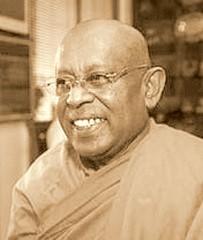
What the Buddha Taught: Revised and Exp... A source page for quotes linked to Walpola Rahula. 0 quotes
“First of all, Buddhism is neither pessimistic nor optimistic. If anything at all, it is realistic, for it takes a realistic view of life and the world. It looks at things objectively (yathābhūtam). It does not falsely lull you into living in a fool's paradise, nor does it frighten and agonize you with all kinds of imaginary fears and sins. It tells you exactly and objectively what you are and what the world around you is, and shows you the way to perfect freedom, peace, tranquility and happiness.” PhilosophyTruthReligionBuddhismBalanceObjectivityObjectivismMiddle WayMiddle PathThe Middle PathThe Middle Way Book:What the Buddha Taught Source: What the Buddha Taught
“What we call life...is the combination of the Five Aggregates, a combination of physical and mental energies. These are constantly changing; they do not remain the same for two consecutive moments. Every moment they are born and they die. 'When the Aggregates arise, decay and die, O bhikkhu, every moment you are born, decay, and die.' This, even now during this life time, every moment we are born and die, but we continue. If we can understand that in this life we can continue without a permanent, unchanging substance like Self or Soul, why can't we understand that those forces themselves can continue without a Self or a Soul behind them after the non-functioning of the body?” DeathChangeDyingBuddhismReincarnationLife After DeathLife EnergyFive Aggregates Book:What the Buddha Taught Source: What the Buddha Taught
“One physician may gravely exaggerate an illness and give up hope altogether. Another may ignorantly declare that there is no illness and that no treatment is necessary, thus deceiving the patient with false consolation. You may call the first one pessimistic and the second one optimistic. Both are equally dangerous.” PhilosophyBuddhismOptimismPessimism Author:Walpola Rahula
“If by the expression "not practical" you mean "not easy," you are right. Definitely it is not easy. Yet it should be tried. You may say it is risky trying it. Surely it cannot be more risky than trying a nuclear war.” IfsShouldTryingMayMeanWarEasyExpressionNuclearPracticalsNuclear War Book:What the Buddha Taught Source: What the Buddha Taught
“The question has often been asked; Is Buddhism a religion or a philosophy? It does not matter what you call it. Buddhism remains what it is whatever label you may put on it. The label is immaterial. Even the label 'Buddhism' which we give to the teachings of the Buddha is of little importance. The name one gives is inessential.... In the same way Truth needs no label: it is neither Buddhist, Christian, Hindu nor Moslem. It is not the monopoly of anybody. Sectarian labels are a hindrance to the independent understanding of Truth, and they produce harmful prejudices in men's minds.” MenWayNeedsGivingMindMayLittlesDoeMatterPhilosophyChristianNamesUnderstandingTeachingProduceBuddhismImportancePrejudiceIndependentRemainsBuddhistLabelsMonopolyHindrance Book:What the Buddha Taught Source: What the Buddha Taught
“There is no unmoving mover behind the movement. It is only movement. It is not correct to say that life is moving, but life is movement itself. Life and movement are not two different things. In other words, there is no thinker behind the thought. Thought itself is the thinker. If you remove the thought, there is no thinker to be found.” IfsTwoDifferentMovingLife IsFoundBehindsMovementDifferent ThingsRemoveThinkerTwo Different Things Book:What the Buddha Taught Source: What the Buddha Taught
“First of all, Buddhism is neither pessimistic nor optimistic. If anything at all, it is realistic, for it takes a realistic view of life and the world. It looks at things objectively (yath?bh?tam). It does not falsely lull you into living in a fool's paradise, nor does it frighten and agonize you with all kinds of imaginary fears and sins. It tells you exactly and objectively what you are and what the world around you is, and shows you the way to perfect freedom, peace, tranquility and happiness.” IfsWorldWayFirstsLooksKindDoeShowsSinPerfectViewsBuddhismFoolBalanceAll KindsOptimisticParadiseRealisticImaginaryTranquilityPessimisticLullsPeace Tranquility Author:Walpola Rahula
“According to the Buddha's teaching the beginning of the life-stream of living beings is unthinkable. THe believer in the creation of life by God may be astonished at this reply. But if you were to ask him 'What is the beginning of God?' he would answer without hesitation 'God has no beginning', and he is not astonished at his own reply.” IfsMayAsksAnswersTeachingCreationBelieverStreamsHesitationUnthinkable Book:What the Buddha Taught Source: What the Buddha Taught
“Two ideas are psychologically deep-rooted in man: self-protection and self-preservation. For self-protection man has created God, on whom he depends for his own protection, safety and security, just as a child depends on its parent. For self-preservation man has conceived the idea of an immortal Soul or Atman, which will live eternally. In his ignorance, weakness, fear, and desire, man needs these two things to console himself. Hence he clings to them deeply and fanatically.” MenNeedsChildrenTwoIdeasSoulSelfDesireParentSecurityIgnoranceDependsWeaknessSafetyProtectionTwo ThingsImmortalRootedPreservationConsoleSelf PreservationImmortal SoulAtmanSelf ProtectionSafety And Security Author:Walpola Rahula
“As long as you are conscious of yourself, you can never concentrate on anything.” LongConscious Book:What the Buddha Taught: Revised and Expanded Edition with Texts from Suttas and Dhammapada Source: What the Buddha Taught: Revised and Expanded Edition with Texts from Suttas and Dhammapada
“It is always a question of knowing and seeing, and not that of believing. The teaching of the Buddha is qualified as ehi-passika, inviting you to 'come and see', but not to come and believe.” BelieveBeliefKnowingSeeingTeachingQualifiedInviting Book:What the Buddha Taught Source: What the Buddha Taught
“All great work artistic, poetic, intellectual or spiritual is produced at those moments when creators forget themselves altogether and are free from self-consciousness.” SelfMomentsSpiritualForgetConsciousnessIntellectualCreatorArtisticPoeticGreat WorkSelf Consciousness Author:Walpola Rahula