Quotessence
Home / Authors / William Kingdon Clifford
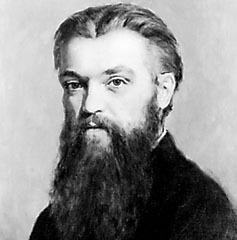
William Kingdon Clifford

William Kingdon Clifford Quotes

Mathematician

Filter quotes by topic

Famous William Kingdon Clifford Quotes

“Newton supposed that the case of the planet was similar to that of [a ball spun around on the end of an elastic string]; that it was always pulled in the direction of the sun, and that this attraction or pulling of the sun produced the revolution of the planet, in the same way that the traction or pulling of the elastic string produces the revolution of the ball. What there is between the sun and the planet that makes each of them pull the other, Newton did not know; nobody knows to this day; and all we are now able to assert positively is that the known motion of the planet is precisely what would be produced if it were fastened to the sun by an elastic string, having a certain law of elasticity. Now observe the nature of this discovery, the greatest in its consequences that has ever yet been made in physical science:— I. It begins with an hypothesis, by supposing that there is an analogy between the motion of a planet and the motion of a ball at the end of a string. II. Science becomes independent of the hypothesis, for we merely use it to investigate the properties of the motion, and do not trouble ourselves further about the cause of it.”

“Euclid's Elements has been for nearly twenty-two centuries the encouragement and guide of that scientific thought which is one thing with the progress of man from a worse to a better state. The encouragement; for it contained a body of knowledge that was really known and could be relied on, and that moreover was growing in extent and application. For even at the time this book was written—shortly after the foundation of the Alexandrian Museum—Mathematics was no longer the merely ideal science of the Platonic school, but had started on her career of conquest over the whole world of Phenomena. The guide; for the aim of every scientific student of every subject was to bring his knowledge of that subject into a form as perfect as that which geometry had attained. Far up on the great mountain of Truth, which all the sciences hope to scale, the foremost of that sacred sisterhood was seen, beckoning for the rest to follow her.”

“Remember that [scientific thought] is the guide of action; that the truth which it arrives at is not that which we can ideally contemplate without error, but that which we may act upon without fear; and you cannot fail to see that scientific thought is not an accompaniment or condition of human progress, but human progress itself.”