Quotessence
Home / Quotes / Quote by Thomas Sowell

Quote by Thomas Sowell

Work

Controversial Essays

This book presents a compilation of essays that tackle contentious issues and stimulate discussion, exploring a range of perspectives on significant subjects. more
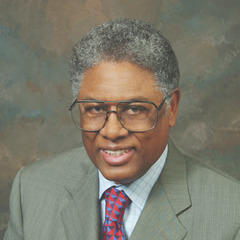
Author

Thomas Sowell
Thomas Sowell

Thomas Sowell is a renowned economist, born on June 30, 1930. His research spans across various fields such as economic policy, race, and social issues, having a profound impact on economics and the social sciences. more

You May Also Like

“Perhaps the most widespread misunderstanding of economics is that it applies solely to financial transactions. Frequently this leads to statements that "there are noneconomic values" to consider. There are, of course, noneconomic values. Indeed, there are only noneconomic values. Economics is not a value itself but merely a method of trading off one value against another.”

“Price fixing does not represent simply windfall gains and losses to particular groups according to whether the price happens to be set higher or lower than it would be otherwise. It represents a net lose to the economy as a whole to the extent that many transactions do not take place at all, because the mutually acceptable possibilities have been reduced.”

“Since man does not create physical matter, those who handle material objects in the production process are not producers in that sense. Economic benefits result from the transformation of matter in form, location, or availability (intellectually or temporally). It is these transformations that create economic benefits valued by consumers, and whoever arranges such transformations contributes to the value of things, whether his hands actually come into contact with physical objects or not.”

“Many of the products which create a modern standard of living are only the physical incorporations of ideas- not only the ideas of an Edison or a Ford but the ideas of innumerable anonymous people who figure out the design of supermarkets, the location of gasoline stations, and the million mundane things on which our material well-being depends. Societies which have more people carrying out physical acts and fewer people supplying ideas do not have higher standards of living. Quite the contrary.”

“Implicit in the activist conception of government is the assumption that you can take the good things in a complex system for granted, and just improve the things that are not so good. What is lacking in this conception is any sense that a society, an institution, or even a single human being, is an intricate system of fragile inter-relationships, whose complexities are little understood and easily destabilized.”

“The most basic inherent constraint is that neither time nor wisdom are free goods available in unlimited quantity. This means that in social processes, as in economic processes, it is not only impossible to attain perfection but irrational to seek perfection- or even to seek the best possible result in each separate instance.”