Quotessence
Home / Authors / Thomas Sowell
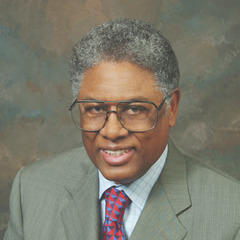
Thomas Sowell

Thomas Sowell Quotes

Economist

Filter quotes by topic

Famous Thomas Sowell Quotes

“The reason so many people misunderstand so many issues is not that these issues are so complex, but that people do not want a factual or analytical explanation that leaves them emotionally unsatisfied. They want villains to hate and heroes to cheer - and they don't want explanations that fail to give them that.”

“External explanations of black-white differences — discrimination or poverty, for example—seem to many to be more amenable to public policy than internal explanations such as culture. Those with this point of view tend to resist cultural explanations but there is yet another reason why some resist understanding the counterproductive effects of an anachronistic culture: Alternative explanations of economic and social lags provide a more satisfying ability to blame all such lags on the sins of others, such as racism or discrimination. Equally important, such external explanations require no painful internal changes in the black population but leave all changes to whites, who are seen as needing to be harangued, threatened, or otherwise forced to change. In short, prevailing explanations provide an alibi for those who lag—and an alibi is for many an enormously valuable asset that they are unlikely to give up easily.”

“Despite widespread misconceptions in the United States today that the institution of slavery was based on race, for most of the thousands of years in which slavery existed around the world, it was based on whoever was vulnerable to enslavement and within striking distance. Thus Europeans enslaved other Europeans, just as Asians enslaved other Asians and Africans enslaved other Africans, while Polynesians enslaved other Polynesians and the indigenous peoples of the Western Hemisphere enslaved other indigenous peoples of the Western Hemisphere. The very word “slave" derived from the word for Slavs, who were enslaved by fellow Europeans for centuries before Africans began to be brought in chains to the Western Hemisphere. Africans were not singled out by a race for ownership by Europeans, they were resorted to after the rise of nation-states with armies and navies in other parts of the world which reduced the number of places that could be raided for slaves without great costs and risks. Slave-raiding continued in Africa, primarily by Africans enslaving other Africans and then, in West Africa, selling some of their slaves to whites to take to the Western Hemisphere. Meanwhile, the growing range of ships and the growing wealth of nations eventually made economically feasible the transportation of vast numbers of slaves from one continent to another, creating racial differences between the enslaved and their owners as a dominant pattern in the Western Hemisphere. Such a pattern was by no means limited to Europeans owning non-Europeans, however. There were many examples of the reverse, quite aside from vast regions of the earth where neither the slaves nor their owners were either black or white.”

“Price controls almost invariably produce black markets, where prices are not only higher than the legally permitted prices, but also higher than they would be in a free market, since the legal risks must also be compensated. While small-scale black markets may function in secrecy, large-scale black markets usually require bribes to officials to look the other way.”

“The staunchest conservatives advocate a range of changes which differ in specifics, rather than in number or magnitude, from the changes advocated by those considered liberal…change, as such, is simply not a controversial issue. Yet a common practice among the anointed is to declare themselves emphatically, piously, and defiantly in favor of 'change.' Thus those who oppose their particular changes are depicted as being against change in general. It is as if opponents of the equation 2+2=7 were depicted as being against mathematics. Such a tactic might, however, be more politically effective than trying to defend the equation on its own merits.”

“The key word among advocates of multiculturalism became “diversity.” Sweeping claims for the benefits of demographic and cultural diversity in innumerable institutions and circumstances have prevailed without a speck of evidence being asked for or given. It is one of the purest examples of arguments without arguments, and of the force of sheer repetition, insistence and intimidation.”

“However much history may be invoked in support of these policies (affirmative action), no policy can apply to history but can only apply to the present or the future. The past may be many things, but it is clearly irrevocable. Its sins can no more be purged than its achievements can be expunged. Those who suffered in centuries past are as much beyond our help as those who sinned are beyond our retribution.”

“Page 141: Group Polarization Patterns Political anger and demands for privileges are, of course, not limited to the less privileged. Indeed, even when demands are made in the name of less privileged racial or ethnic groups, often it is the more privileged members of such groups who make the demands and who benefit from policies designed to meet such demands. These demands may erupt suddenly in the wake of the creation (or sharp enlargement) of a newly educated class which sees its path to coveted middle-class professions blocked by competition of other groups--as in India, French Canada, or Lithuania, for example. * * * A rapid expansion of education is thus a factor in producing inter-group conflict, especially where the education is of a kind which produces diplomas rather than skills that have significant economic value in the marketplace. Education of a sort useful only for being a clerk, bureaucrat, school teacher--jobs whose numbers are relatively fixed in the short run and politically determined in the long run--tend to increase politicized inter-group strife. Yet newly emerging groups, whether in their own countries or abroad, tend to specialize precisely in such undemanding fields. Malay students, for example, have tended to specialize in Malay studies and Islamic studies, which provide them with no skills with which compete with the Chinese in the marketplace, either as businessmen, independent professionals, or technicians. Blacks and Hispanics in the United States follow a very similar pattern of specializing disproportionately in easier fields which offer less in the way of marketable skills. Such groups then have little choice but to turn to the government, not just for jobs but also for group preferences to be imposed in the market place, and for symbolic recognition in various forms. *** While economic interests are sometimes significant in explaining political decisions, they are by no means universally valid explanations. Educated elites from less advanced groups may have ample economic incentives to promote polarization and preferential treatment policies, but the real question is why the uneducated masses from such groups give them the political support without which they would be impotent. Indeed, it is often the less educated masses who unleash the mob violence from which their elite compatriots ultimately benefit--as in Malaysia, Sri Lanka, or parts of India, Africa, or the United States, where such violence has led to group preference policies in employment, educational institutions, and elsewhere. The common denominator in these highly disparate societies seems to be not only resentment of other groups' success but also fear of an inability to compete with them, combined with a painful embarrassment at being so visibly "under-represented"--or missing entirely—in prestigious occupations and institutions. To remedy this within apolitically relevant time horizon requires not simply increased opportunities but earmarked benefits directly given on a racial or ethnic basis.”

“Affirmative action hiring pressures make it costly to have no minority employees, but continuing affirmative action pressures at the promotion and discharge phases also make it costly to have minority employees who do not work out well. The net effect is to increase the demand for highly qualified minority employees while decreasing the demand for less qualified minority employees or for those without a sufficient track record to reassure employers.”

“Page 141: Political anger and demands for privileges are, of course, not limited to the less privileged. Indeed, even when demands are made in the name of less privileged racial or ethnic groups, often it is the more privileged members of such groups who make the demands and who benefit from policies designed to meet such demands. These demands may erupt suddenly in the wake of the creation (or sharp enlargement) of a newly educated class which sees its path to coveted middle-class professions blocked by competition of other groups--as in India, French Canada, or Lithuania, for example.”

“Information or allegations reflecting negatively on individuals or groups seen less sympathetically by the intelligentsia pass rapidly into the public domain with little scrutiny and much publicity. Two of the biggest proven hoaxes of our time have involved allegations of white men gang-raping a black woman-- first the Tawana Brawley hoax of 1987 and later the false rape charges against three Duke University students in 2006. In both cases, editorial indignation rang out across the land, without a speck of evidence to substantiate either of these charges. Moreover, the denunciations were not limited to the particular men accused, but were often extended to society at large, of whom these men were deemed to be symptoms or 'the tip of the iceberg.' In both cases, the charges fit a pre-existing vision, and that apparently made mundane facts unnecessary. Another widely publicized hoax-- one to which the President of the United States added his sub-hoax-- was a 1996 story appearing in USA Today under the headline, 'Arson at Black Churches Echoes Bigotry of the Past.' There was, according to USA Today, 'an epidemic of church burning,' targeting black churches. Like the gang-rape hoaxes, this story spread rapidly through the media. The Chicago Tribune referred to 'an epidemic of criminal and cowardly arson' leaving black churches in ruins. As with the gang-rape hoaxes, comments on the church fire stories went beyond those who were supposed to have set these fires to blame forces at work in society at large. Jesse Jackson was quoted was quoted in the New York Times as calling these arsons part of a 'cultural conspiracy' against blacks, which 'reflected the heightened racial tensions in the south that have been exacerbated by the assault on affirmative action and the populist oratory of Republican politicians like Pat Buchanan.' Time magazine writer Jack White likewise blamed 'the coded phrases' of Republican leaders for 'encouraging the arsonists.' Columnist Barbara Reynolds of USA Today said that the fires were 'an attempt to murder the spirit of black America.' New York Times columnist Bob Herbert said, "The fuel for these fires can be traced to a carefully crafted environment of bigotry and hatred that was developed over the last century.' As with the gang-rape hoaxes, the charges publicized were taken as reflecting on the whole society, not just those supposedly involved in what was widely presumed to be arson, rather than fires that break out for a variety of other reasons. Washington Post columnist Dorothy Gilliam said that society in effect was 'giving these arsonists permission to commit these horrible crimes.' The climax of these comments came when President Bill Clinton, in his weekly radio address, said that these church burnings recalled similar burnings of black churches in Arkansas when he was a boy. There were more that 2,000 media stories done on the subject after the President's address. This story began to unravel when factual research showed that (1) no black churches were burned in Arkansas when Bill Clinton was growing up, (2) there had been no increase in fires at black churches, but an actual decrease over the previous 15 years, (3) the incidence of fires at white churches was similar to the incidence of fires at black churches, and (4) where there was arson, one-third of the suspects were black. However, retractions of the original story-- where there were retractions at all-- typically were given far less prominence than the original banner headlines and heated editorial comments.”

“In a world where every society and every civilization has borrowed heavily from the cultures of other societies and other civilizations, everyone does not have to go back to square one and discover fire and the wheel for himself, when someone else has already discovered it. Europeans did not have to continue copying scrolls by hand after the Chinese invented paper and printing. Malaysia could become the world’s leading rubber-producing nation after planting seeds taken from Brazil. Yet the equal-respect “identity” promoters would have each group paint itself into its own little corner, with its own insular culture, thus presenting over all a static tableau of “diversity,” rather than the dynamic process of competition on which the progress of the human race has been based for thousands of years.”

“The concept of “microaggression” is just one of many tactics used to stifle differences of opinion by declaring some opinions to be “hate speech,” instead of debating those differences in a marketplace of ideas. To accuse people of aggression for not marching in lockstep with political correctness is to set the stage for justifying real aggression against them.”

“How, then, can women as a group be so far behind men as a group, in both incomes and occupations? Because most women become wives and mothers and the economic results are totally different from a man's becoming a husband and father. However parallel these roles may be verbally, they are vastly different in behavioral consequences. There are reasons why there are no homes for unwed fathers.”

“With women, as with racial and ethnic minorities, the effects of policies must be carefully separated from the intentions of those policies. The crucial question is not the desirability of the professed goal but the incentives and constraints created and what they are most likely to lead to. The imposition of monthly equality in pensions, rather than lifetime equality, has the net effect of making pension plans more expensive, the more female employees there are [because women live longer than men]. Viewed as prospective behavioral incentives, rather than as a retrospective status pronouncement, this means that employers will find it more costly to hire female work- ers with a given pension plan and more costly to institute a given pension plan when there are more female workers. Reducing the demand for female workers or reducing the likelihood of creating a pension plan is hardly the intention of the courts, but it can easily be the result. It is not clear that anyone is economically better off after such a symbolic ruling.”

“To many people today, slavery means white people holding black people in bondage. The vast millions of people around the world who were neither white nor black, but who were either slaves or enslavers for centuries, fade out of this vision of slavery, as if they had never existed, even though they may well have outnumbered both blacks and whites. It has been estimated that there were more slaves in India than in the entire Western Hemisphere. China during the era of slavery has been described as “one of the largest and most comprehensive markets for the exchange of human beings in the world.” Slaves were a majority of the population in some of the cities in Southeast Asia. At some period or other in history, as John Stuart Mill pointed out, “almost every people, now civilized, have consisted, in majority, of slaves.”

“People who want special taxes or subsidies for particular things seem not to understand that what they are really asking for is for prices to misstate the relative scarcities of things and the relative values that the users of these things put on them. . . Making anything artificially cheap usually means that it will be wasted.”

“What was peculiar about the West was not that it participated in the worldwide evil of slavery, but that it later abolished that evil, not only in Western societies but also in other societies subject to Western control or influence. This was possible only because the anti-slavery movement coincided with an era in which Western power and hegemony were at their zenith, so that it was essentially European imperialism which ended slavery. This idea might seem shocking, not because it does not fit the facts, but because it does not fit the prevailing vision of our time.”

“If one chooses to call tests that require the mastery of abstractions culturally biased, because some cultures put more emphasis on abstractions than others, that raises fundamental questions about what the tests are for. In a world where the ability to master abstractions is fundamental to mathematics, science and other endeavors, the measurement of that ability is not an arbitrary bias. A culture-free test might be appropriate in a culture-free society—but there are no such societies.”

“Only optimists thought this possible at the time and even the leaders of the anti-slavery movement did not at first attempt the direct abolition of the institution of slavery itself, hoping instead that stopping the buying and selling of human beings would dry up the source and cause slavery as an institution to wither on the vine. At this juncture in history, Britain was the world's largest slave trader and the powerful vested interests which this created were able to roundly defeat early attempts to get Parliament to ban the trade. In the long run, however, such powerful opposition to the proposed ban, combined with equal tenacity on the other side, simply dragged out the political struggle for decades, making ever wider circles of people aware of the issue. Something that had never been a public issue before now became a subject of inescapable and heated controversy for years on end. Slavery could no longer be accepted as simply one of those facts of life that most people do not bother to think about. The long, drawn-out political controversy meant that more and more people had to think about it—and many who began to think about slavery turned against it. Eventually, such strong feelings were aroused among the British public that anti-slavery petitions with unprecedented numbers of signatures poured into Parliament from around the country, from people in all walks of life, until the mounting political pressures forced not only a banning of the international slave trade in 1808, but eventually swept the anti-slavery forces on beyond their original goals toward the direct abolition of the institution of slavery itself.”

“Despite the massive intellectual feat that Marx's Capital represents, the Marxian contribution to economics can be readily summarized as virtually zero. Professional economics as it exists today reflects no indication that Karl Marx ever existed. This neither denies nor denigrates Capital as an intellectual achievement, and perhaps in its way the culmination of classical economics. But the development of modern economics had simply ignored Marx. Even economists who are Marxists typically utilize a set of analytical tools to which Marx contributed nothing, and have recourse to Marx only for ideological, political, or historical purposes. In professional economics, Capital was a detour into a blind alley, however historic it may be as the centerpiece of a worldwide political movement. What is said and done in its name is said and done largely by people who have never read through it, much less followed its labyrinthine reasoning from its arbitrary postulates to its empirically false conclusions. Instead, the massive volumes of Capital have become a quasi-magic touchstone—a source of assurance that somewhere and somehow a genius "proved" capitalism to be wrong and doomed, even if the specifics of this proof are unknown to those who take their certitude from it.”

“The Marxist constituency has remained as narrow as the conception behind it. The Communist Manifesto, written by two bright and articulate young men without responsibility even for their own livelihoods—much less for the social consequences of their vision—has had a special appeal for successive generations of the same kinds of people. The offspring of privilege have dominated the leadership of Marxist movements from the days of Marx and Engels through Lenin, Mao, Castro, Ho Chi Minh, and their lesser counterparts around the world and down through history. The sheer reiteration of the "working class" theme in Marxism has drowned out this plain fact.”

“White liberals, instead of comparing what has happened to the black family since the liberal welfare state policies of the 1960s were put into practice, compare black families to white families and conclude that the higher rates of broken homes and unwed motherhood among blacks are due to “a legacy of slavery.” But why the large-scale disintegration of the black family should have begun a hundred years after slavery is left unexplained. Whatever the situation of the black family relative to the white family, in the past or the present, it is clear that broken homes were far more common among blacks at the end of the twentieth century than they were in the middle of that century or at the beginning of that century —even though blacks at the beginning of the twentieth century were just one generation out of slavery. The widespread and casual abandonment of their children, and of the women who bore them, by black fathers in the ghettos of the late twentieth century was in fact a painfully ironic contrast with what had happened in the immediate aftermath of slavery a hundred years earlier, when observers in the South reported desperate efforts of freed blacks to find family members who had been separated from them during the era of slavery.”

“The dominant orthodoxy in development economics was that Third World countries were trapped in a vicious cycle of poverty that could be broken only by massive foreign aid from the more prosperous industrial nations of the world. This was in keeping with a more general vision on the Left that people were essentially divided into three categories - the heartless, the helpless, and wonderful people like themselves, who would rescue the helpless by playing Lady Bountiful with the taxpayers' money.”