Quotessence
Home / Quotes / Quote by Thomas Sowell

Quote by Thomas Sowell

Work

Intellectuals and Society

Browse quotes and source details for this work. more

Author
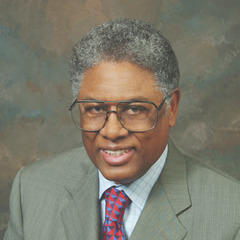
Thomas Sowell
Thomas Sowell

Thomas Sowell is a renowned economist, born on June 30, 1930. His research spans across various fields such as economic policy, race, and social issues, having a profound impact on economics and the social sciences. more

You May Also Like

“I used to be afraid about what people might say or think after reading what I had written. I am not afraid anymore, because when I write, I am not trying to prove anything to anyone, I am just expressing myself and my opinions. It’s ok if my opinions are different from those of the reader, each of us can have his own opinions. So writing is like talking, if you are afraid of writing, you may end up being afraid of talking”

“The human race is a letdown, Ernest — a bad, bad letdown. And I’m disgusted with it. It thinks it’s progressed, but it hasn’t. It thinks it’s risen above the primeval slime, but it hasn’t. It’s wallowing in it. It’s still clinging to us, clinging to our hair and to our eyes and to our souls. We’ve invented a few things that make noises, but we haven’t invented one big thing that creates quiet. Endless, peaceful quiet. Something to pull over us like a gigantic eiderdown, something to deaden the sound of our emotional yellings and screechings and suffocate our psychological confusions.”

“The entire pre-Columbian literature of Mexico, a vast library of tens of thousands of codices, was carefully and systematically destroyed by the priests and friars who followed in the wake of the conquistadors. In November 1530, for example, Bishop Juan de Zumárraga, who had shortly before been apointed 'Protector of the Indians' by the Spanish crown, proceeded to 'protect' his flock by burning at the stake a Mexican aristocrat, the lord of the city of Texcoco, whom he accused of having worshipped the rain god. In the city's marketplace Zumárraga 'had a pyramid formed of the documents of Aztec history, knowledge and literature, their paintings, manuscripts, and hieroglyphic writings, all of which he committed to the flames while the natives cried and prayed.' More than 30 years later, the holocaust of documents was still under way. In July 1562, in the main square of Mani (just south of modern Merida in the Yucatan), Bishop Diego de Landa burned thousands of Maya codices, story paintings, and hieroglyphs inscribed on rolled-up deer skins. He boasted of destroying countless 'idols' and 'altars,' all of which he described as 'works of the devil, designed by the evil one to delude the Indians and to prevent them from accepting Christianity.' Noting that the Maya 'used certain characters or letters, which they wrote in their books about the antiquities and their sciences' he informs us: 'We found a great number of books in these letters, and since they contained nothing but superstitions and falsehoods of the devil we burned them all, which they took most grievously and which gave them great pain.”

“The British Sonnet Rule Britannia, Britannia rule the waves. Britons never, never, never, Shall be slaves. Around the world we looted, We even championed slavery. But none of it really matters, Consequences don't apply to royalty. Hitler massacred so many people, Which is petty compared to our atrocities. Perhaps that's why Britain is so great, None can compete with our killing spree. It's time to civilize this backward Britannia, By righting the wrongs of British Barbariana”

“It was Hypatia’s fault, said the Christians, that the governor was being so stubborn. It was she, they murmured, who was standing between Orestes and Cyril, preventing them from reconciling. Fanned by the parabalani, the rumours started to catch, and flame. Hypatia was not merely a difficult woman, they said. Hadn’t everyone seen her use symbols in her work, and astrolabes? The illiterate parabalani (‘bestial men – truly abominable’ as one philosopher would later call them) knew what these instruments were. They were not the tools of mathematics and philosophy, no: they were the work of the Devil. Hypatia was not a philosopher: she was a creature of Hell. It was she who was turning the entire city against God with her trickery and her spells. She was ‘atheizing’ Alexandria. Naturally, she seemed appealing enough – but that was how the Evil One worked. Hypatia, they said, had ‘beguiled many people through satanic wiles’. Worst of all, she had even beguiled Orestes. Hadn’t he stopped going to church? It was clear: she had ‘beguiled him through her magic’. This could not be allowed to continue. One day in March AD 415, Hypatia set out from her home to go for her daily ride through the city. Suddenly, she found her way blocked by a ‘multitude of believers in God’. They ordered her to get down from her chariot. Knowing what had recently happened to her friend Orestes, she must have realized as she climbed down that her situation was a serious one. She cannot possibly have realized quite how serious. As soon as she stood on the street, the parabalani, under the guidance of a Church magistrate called Peter – ‘a perfect believer in all respects in Jesus Christ’ – surged round and seized ‘the pagan woman’. They then dragged Alexandria’s greatest living mathematician through the streets to a church. Once inside, they ripped the clothes from her body then, using broken pieces of pottery as blades, flayed her skin from her flesh. Some say that, while she still gasped for breath, they gouged out her eyes. Once she was dead, they tore her body into pieces and threw what was left of the ‘luminous child of reason’ onto a pyre and burned her.”