Quotessence
Home / Quotes / Quote by Thomas Sowell

Quote by Thomas Sowell

“Despite the massive intellectual feat that Marx's Capital represents, the Marxian contribution to economics can be readily summarized as virtually zero. Professional economics as it exists today reflects no indication that Karl Marx ever existed. This neither denies nor denigrates Capital as an intellectual achievement, and perhaps in its way the culmination of classical economics. But the development of modern economics had simply ignored Marx. Even economists who are Marxists typically utilize a set of analytical tools to which Marx contributed nothing, and have recourse to Marx only for ideological, political, or historical purposes. In professional economics, Capital was a detour into a blind alley, however historic it may be as the centerpiece of a worldwide political movement. What is said and done in its name is said and done largely by people who have never read through it, much less followed its labyrinthine reasoning from its arbitrary postulates to its empirically false conclusions. Instead, the massive volumes of Capital have become a quasi-magic touchstone—a source of assurance that somewhere and somehow a genius "proved" capitalism to be wrong and doomed, even if the specifics of this proof are unknown to those who take their certitude from it.”

Quote by Thomas Sowell

Work

Marxism: Philosophy and Economics

Browse quotes and source details for this work. more

Author
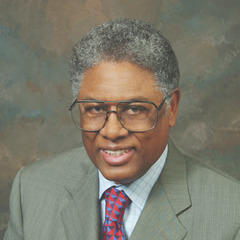
Thomas Sowell
Thomas Sowell

Thomas Sowell is a renowned economist, born on June 30, 1930. His research spans across various fields such as economic policy, race, and social issues, having a profound impact on economics and the social sciences. more

You May Also Like

“The Marxist constituency has remained as narrow as the conception behind it. The Communist Manifesto, written by two bright and articulate young men without responsibility even for their own livelihoods—much less for the social consequences of their vision—has had a special appeal for successive generations of the same kinds of people. The offspring of privilege have dominated the leadership of Marxist movements from the days of Marx and Engels through Lenin, Mao, Castro, Ho Chi Minh, and their lesser counterparts around the world and down through history. The sheer reiteration of the "working class" theme in Marxism has drowned out this plain fact.”

“Je ne comprends pas que l'on puisse ne pas fumer. C'est se priver de toute façon de la meilleure part de l'existence et en tout cas d'un plaisir tout à fait éminent. Lorsque je m'éveille, je me réjouis déjà de pouvoir fumer pendant la journée, et pendant que je mange, j'ai la même pensée, oui, je peux dire qu'en somme je mange seulement pour pouvoir ensuite fumer, et je crois que j'exagère à peine. Mais un jour sans tabac, ce serait pour moi le comble de la fadeur, ce serait une journée absolument vide et insipide, et si, le matin, je devais me dire : "aujourd'hui je n'aurai rien à fumer", je crois que je n'aurais pas le courage de me lever, je te jure que je resterais couché. [...] Dieu merci ! on fume dans le monde entier ; ce plaisir, autant que je sache, n'est inconnu nulle part où l'on pourrait être jeté par les hasards de la vie. Même les explorateurs qui partent pour le pôle nord se pourvoient largement de provisions de tabac pour la durée de leurs pénibles étapes, et j'ai toujours trouvé cela sympathique lorsque je l'ai lu. Car on peut aller très mal - supposons par exemple que je sois dans un état lamentable -, aussi longtemps que j'aurai mon cigare, je le supporterai, je le sais bien ; il m'aiderait à tout surmonter.”

“I decided I might be able to substitute a tobacco cigarette with one made from spearmint. I made up my mind that if I was going to keep smoking, I had to find something less expensive to smoke. I did not mention this in my composition book, but have decided to mention it now. It is a good example of a bad substitute. There is no safe cigarette.”