“Do not, however, mistake me. It is not to my good friend's heresy that I impute his honesty. On the contrary, 'tis his honesty that brought upon him the character of a heretic.”
Quote by Benjamin Franklin
Work
The Private Correspondence of Benjamin Franklin .. Comprising a Series of Letters on Miscellaneous, Litarary, and Political Subjects: Written Between the Years 1753 and 1790; Illustrating the Memoirs of His Public and Private Life, and Developing the Secret History of His Political Transactions and Negociations. Now First Published from the Originals
The Private Correspondence of Benjamin Franklin presents a comprehensive collection of Franklin's personal and professional letters. Spanning over three decades, these letters provide a unique perspective on Franklin's life and work. The correspondence touches on a wide range of subjects, from scientific inquiries to political debates, offering a rich tapestry of Franklin's intellectual and social world. This volume is the first published edition from the original manuscripts, providing readers with an authentic view of Franklin's thoughts and experiences. more
Author
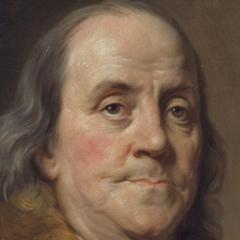
Benjamin Franklin
Benjamin Franklin was a prominent figure in American history, serving as one of the Founding Fathers of the United States. He was a statesman, scientist, inventor, and writer, born on January 17, 1706, and died on April 17, 1790. Franklin is renowned for his contributions to electricity, his support for the American colonial independence movement, and his successful diplomatic efforts in France. more
You May Also Like
Source: The Life of Benjamin Franklin, Written by Himself
Source: Memoirs of Benjamin Franklin; Written by Himself: With His Most Interesting Essays, Letters, and Miscellaneous Writings, Familiar, Moral, Political, Economical, and Philosophical
Source: Representative selections: with introduction, bibliography, and notes
Source: Selected Writings of James Madison
Source: James Madison's
Source: Selected Writings of James Madison
Source: The Federalist: A Commentary on the Constitution of the United States
Source: James Madison's