Quotessence
Home / Quotes / Quote by Steven Pinker

Quote by Steven Pinker

“People who are depressed at the thought that all our motives are selfish are [confused]. They have mixed up ultimate causation (why something evolved by natural selection) with proximate causation (how the entity works here and now). [A] good way to understand the logic of natural selection is to imagine that genes are agents with selfish motives. [T]he genes have metaphorical motives — making copies of themselves — and the organisms they design have real motives. But they are not the same motives. Sometimes the most selfish thing a gene can do is wire unselfish motives into a human brain — heartfelt, unstinting, deep-in-the-marrow unselfishness. The love of children (who carry one's genes into posterity), a faithful spouse (whose genetic fate is identical to one's own), and friends and allies (who trust you if you're trustworthy) can be bottomless and unimpeachable as far as we humans are concerned (proximate level), even if it is metaphorically self-serving as far as the genes are concerned (ultimate level). Combine this with the common misconception that the genes are a kind of essence or core of the person, and you get a mongrel of Dawkins and Freud: the idea that the metaphorical motives of the genes are the deep, unconscious, ulterior motives of the person. That is an error.”

Quote by Steven Pinker

Work

The Blank Slate: The Modern Denial of Human Nature

This book delves into the debate over the influence of nature versus nurture on human behavior, examining the implications of this debate on various aspects of society and psychology. more

Author
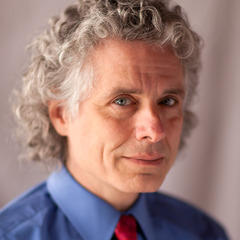
Steven Pinker
Steven Pinker

Steven Pinker is a renowned cognitive psychologist, linguist, and author. His research focuses on language, cognition, and human behavior, particularly the relationship between language and thought. Pinker is known for his in-depth research on the evolution of language and his contributions to the field of cognitive science. more

You May Also Like

“The long-lived gene as an evolutionary unit is not any particular physical structure but the textual archival information that is copied on down the generations. [I]t is widely distributed in space among different individuals, and widely distributed in time over many generations. [A] successful gene will be one that does well in the environments provided by these other genes that it is likely to meet in lots of different bodies.”

“Ohm found that the results could be summed up in such a simple law that he who runs may read it, and a schoolboy now can predict what a Faraday then could only guess at roughly. By Ohm's discovery a large part of the domain of electricity became annexed by Coulomb's discovery of the law of inverse squares, and completely annexed by Green's investigations. Poisson attacked the difficult problem of induced magnetisation, and his results, though differently expressed, are still the theory, as a most important first approximation. Ampere brought a multitude of phenomena into theory by his investigations of the mechanical forces between conductors supporting currents and magnets. Then there were the remarkable researches of Faraday, the prince of experimentalists, on electrostatics and electrodynamics and the induction of currents. These were rather long in being brought from the crude experimental state to a compact system, expressing the real essence. Unfortunately, in my opinion, Faraday was not a mathematician. It can scarcely be doubted that had he been one, he would have anticipated much later work. He would, for instance, knowing Ampere's theory, by his own results have readily been led to Neumann's theory, and the connected work of Helmholtz and Thomson. But it is perhaps too much to expect a man to be both the prince of experimentalists and a competent mathematician.”

“see rainbows in rainstorms and opportunities in disasters. When life hands me lemons, I whip up a lemon meringue pie. Challenges? Just plot twists in my epic saga, and setbacks are setups for my grand comeback. Where others see roadblocks, I see shortcuts to awesomeness. My glass isn’t just half full; it’s practically overflowing with optimism. So, while the world tosses curveballs, I’m here with my metaphorical bat, ready to hit them out of the park and do a victory dance.”