Quotessence
Home / Quotes / Quote by Gregory of Nazianzus

Quote by Gregory of Nazianzus

Author

Gregory of Nazianzus

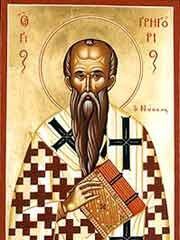
Gregory of Nazianzus (330-390 AD) was an influential Christian saint, theologian, and poet. He is renowned for his contributions to the doctrine of the Trinity within Christian theology. Born in Nazianzus, Asia Minor, he was the brother of Basil of Caesarea, another prominent theologian. His writings and sermons are still widely referenced in the Christian church today. more

You May Also Like

“...just as the edifice of all the virtues strives upward toward perfect prayer so will all these virtues be neither sturdy nor enduring unless they are drawn firmly together by the crown of prayer. This endless, unstirring calm of prayer... can neither be achieved nor consummated without these virtues. And likewise virtues are the prerequisite foundation of prayer and cannot be effected without it.”

“How could it occur to anyone to demonstrate that God exists unless one has already allowed Himself to ignore Him? A king's existence is demonstrated by way of subjection and submissiveness. Do you want to try and demonstrate that the king exists? Will you do so by offering a string of proofs, a series of arguments? No. If you are serious, you will demonstrate the king's existence by your submission, by the way you live. And so it is with demonstrating God's existence. It is accomplished not by proofs but by worship. Any other way is but a thinker's pious bungling.”

“...if we know God our knowledge of... everything will be brought to perfection, and, in so far as is possible, the infinite, divine and ineffable dwelling place (cf. Jn. 14:2) will be ours to enjoy. For this is what our sainted teacher said in his famous philosophical aphorism: 'Then we shall know as we are known' (I Cor. 13:12), when we mingle our god-formed mind and divine reason to what is properly its own and the image returns to the archetype for which it now longs.”

“...the reason for [this age's] anxiety and unrest is because in one direction, 'truth' increases in scope and quantity - via science and technology - while in the other, certainty and confidence steadily decline. Our age is a master in developing truths while being wholly indifferent to certitude. It lacks confidence in the good.”

“Can anyone be a father without beginning to be one? Yes, one who did not begin his existence. What begins to exist begins to be a father - God the Father did not begin at all. He is Father in the true sense, because He is not a son as well. Just as the Son is son in the true sense, because He is not a father as well. In our case, the word 'father' cannot be truly appropriate, because we must be fathers and sons.”

“The name 'cherubim' means 'fullness of knowledge' or 'outpouring of wisdom'... The name cherubim signifies the power to know and to see God, to receive the greatest gifts of His light, to contemplate the divine splendor in primordial power, to be filled with the gifts that bring wisdom and to share these generously with subordinates as a part of the beneficent outpouring of His wisdom.”

“How is it... that the Son and Holy Spirit are not co-unoriginate with the Father, if they are co-eternal with Him? Because they are from Him, though not after Him. 'Being unoriginate' necessarily implies 'being eternal,' but 'being eternal' does not entail 'being unoriginate,' so long as the Father is referred to as origin. So because They have a cause They are not unoriginate... a cause is not necessarily prior to its effects... Because time is not involved, They are to that extent unoriginate... for the sources of time are not subject to time.”

“It is not our free will but 'it is the Lord who sets the captive free' (Ps. 145:7). It is not our own virtue but 'it is the Lord who lifts up those who were laid low' (Ps. 145:8). It is not application to reading but 'it is the Lord who gives light to the blind' (Ps. 145:8). It is not our cautiousness but 'it is the Lord who protects the stranger' (Ps. 145:9). It is not our endurance but 'it is the Lord who raises or gives support to the fallen' (Ps. 144:14).”