Quotessence
Home / Quotes / Quote by Pope Dionysius

Quote by Pope Dionysius

“...if we know God our knowledge of... everything will be brought to perfection, and, in so far as is possible, the infinite, divine and ineffable dwelling place (cf. Jn. 14:2) will be ours to enjoy. For this is what our sainted teacher said in his famous philosophical aphorism: 'Then we shall know as we are known' (I Cor. 13:12), when we mingle our god-formed mind and divine reason to what is properly its own and the image returns to the archetype for which it now longs.”

Quote by Pope Dionysius

Author
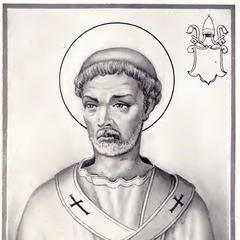
Pope Dionysius
Pope Dionysius

Pope Dionysius, the Bishop of Rome, died on December 26, 268. He was an important figure in the early Christian Church, having a profound impact on the organization and development of the Church. more

You May Also Like

“...the reason for [this age's] anxiety and unrest is because in one direction, 'truth' increases in scope and quantity - via science and technology - while in the other, certainty and confidence steadily decline. Our age is a master in developing truths while being wholly indifferent to certitude. It lacks confidence in the good.”

“Can anyone be a father without beginning to be one? Yes, one who did not begin his existence. What begins to exist begins to be a father - God the Father did not begin at all. He is Father in the true sense, because He is not a son as well. Just as the Son is son in the true sense, because He is not a father as well. In our case, the word 'father' cannot be truly appropriate, because we must be fathers and sons.”

“The name 'cherubim' means 'fullness of knowledge' or 'outpouring of wisdom'... The name cherubim signifies the power to know and to see God, to receive the greatest gifts of His light, to contemplate the divine splendor in primordial power, to be filled with the gifts that bring wisdom and to share these generously with subordinates as a part of the beneficent outpouring of His wisdom.”

“How is it... that the Son and Holy Spirit are not co-unoriginate with the Father, if they are co-eternal with Him? Because they are from Him, though not after Him. 'Being unoriginate' necessarily implies 'being eternal,' but 'being eternal' does not entail 'being unoriginate,' so long as the Father is referred to as origin. So because They have a cause They are not unoriginate... a cause is not necessarily prior to its effects... Because time is not involved, They are to that extent unoriginate... for the sources of time are not subject to time.”

“It is not our free will but 'it is the Lord who sets the captive free' (Ps. 145:7). It is not our own virtue but 'it is the Lord who lifts up those who were laid low' (Ps. 145:8). It is not application to reading but 'it is the Lord who gives light to the blind' (Ps. 145:8). It is not our cautiousness but 'it is the Lord who protects the stranger' (Ps. 145:9). It is not our endurance but 'it is the Lord who raises or gives support to the fallen' (Ps. 144:14).”

“...night possessed us and the shadow of death encompassed us, for we had fallen into sin and lost the power of sight which was ours by God's grace and by which we were able to perceive the light that bestows true life. Night and death had been poured out on our human nature, not because of any change in the true light, but because we had turned aside and no longer had any inclination towards the life-bearing light. In the last times, however, the Giver of eternal light and Source of true life has had mercy upon us.”

“The word of God has provided nine explanatory designations of the heavenly beings... the first group is forever around God and is said to be permanently united with Him ahead of any of the others and with no intermediary. Here there are the most holy 'thrones' and the orders said to possess many eyes and many wings, called in Hebrew the 'cherubim' and 'seraphim'... The second group... is made up of 'authorities,' 'dominions,' and 'powers.' And the third, at the end of the heavenly hierarchies, is the group of 'angels,' 'archangels,' and 'principalities.'”

“If you are fond of dressing elegantly, or when you put on your clothes, think of the incorruptible garment of righteousness in which our souls should be arrayed, or of Jesus Christ Who is our spiritual raiment, as it is said: 'For as many of you as have been baptized into Christ, have put on Christ' (Gal. 3:27).”