Quotessence
Home / Quotes / Quote by Tyson Chandler

Quote by Tyson Chandler

“I play knowing that there is somebody watching me out there in the crowd that has never had the opportunity to watch a game before and it might be the only chance they ever to see one, live in person. Michael Jordan once said that in an interview, and I really took it to heart, when ever I step on the floor I play for that person. Also, I always know my grandfather's out there watching.”

Quote by Tyson Chandler

Author
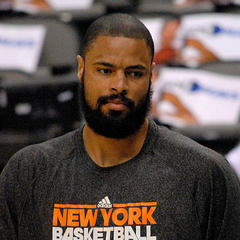
Tyson Chandler
Tyson Chandler

Tyson Chandler, born on October 2, 1982, is an American professional basketball player. He has had a distinguished career in the NBA, playing for teams such as the New Orleans Hornets, Los Angeles Lakers, Charlotte Hornets, and New York Knicks. Known for his exceptional defensive and rebounding skills, Chandler has twice been awarded the NBA Defensive Player of the Year. more

You May Also Like

“I think we've reached that point where we understand medically what we are doing to ourselves with these sports. In football, it's kind of hard to get the access that you want for the story and, of course, it's very long-term: the effects of the repeat concussions really don't hit until decades afterwards, whereas the traumatic injuries in extreme sports are very immediate. I realized Traumatic Brain Injury was a fascinating and important story that not had been told very much. I wanted to know more.”

“I can ask someone to let me into all aspects of their life for several years, but people have got to have that gift: that courage and that talent for opening their lives to the camera. Being candid is a gift, and that's what the audience responds to. Part of it is me asking, and part of it is just their inherent talent, which is what you are looking for when you make documentaries - people that are really going to let you in on what they are going through.”

“There's a theory of accidents that I studied when I was making a film about nuclear weapons: you can never eliminate accidents, because the measures you introduce to prevent accidents actually produce more accidents. That's certainly true of this sport; you're flying over 40 feet of what might look like snow, but it's hard as ice, it's as hard as pavement. You're doing acrobatic spins and tricks, 40 feet above pavement, essentially. There's been more accidents since, and there are going to continue to be more accidents, that's the nature of the sport.”

“Why is nobody questioning the sanity or suicidal tendencies of Everest ascenders? It's kind of a question of framing: How do you frame these activities? We frame them as freedom-loving, exciting, progressing sports and they are. But there are other ways to frame it. It's also true that these young men, neurologists say that their frontal lobes aren't developed yet - the long-term planning part of the brain.”

“So in terms of a large part of the job on our show specifically, what makes the show complex and interesting and funnier are the conversations about "Where's the camera?" and "How aware are the characters of the camera? Are the cameras hidden for this shot? Is it a spy shot from far away? Or is it really close and in their face, and they sort of have to play to it in an embarrassing situation?" There's a whole other level of questions and choices that come into play on our show that are not even a factor in anything else.”

“From my experience working with comedians, there is that competitive aspect. With actors, for instance, they don't want to look competitive even if they are, whereas comedians, I think, are openly happy to play on the idea that they all compete with each other to get the laughs. There's something about comedy, I think, that encourages that. There's this kind of schoolboy sense of wanting to top the other person that we play off of to show them competing for who's smarter or cleverer.”

“The great thing about not having a script is there's nothing you have to shoot that day. When you start filming, you can shoot anything you want. There's no pressure to shoot anything. Whatever interests you that day is what you're shooting. That's a big liberation that makes it more enjoyable and more relaxed. I think if you have that kind of framework it can make it a much more satisfying thing to work on and to watch as well.”

“We're in a situation now where we've got five long-play records of sort of eerie psychedelic pop music. I don't think that we can make another one. That's really my position on it. If we were to do a film soundtrack or something else where I could take the rest of the band with me. I really don't think bands should make more than five records anyway. In fact, five is one too many. We'll have to see how it pans out.”