Quotessence
Home / Quotes / Quote by John Dewey

Quote by John Dewey

“What, after all, is the public under present conditions? What are the reasons for its eclipse? What hinders it from finding and identifying itself? By what means shall its inchoate and amorphous estate be organized into effective political action relevant to present social needs and opportunities? What has happened to the public in the century and a half since the theory of political democracy was urged with such assurance and hope?”

Quote by John Dewey

Author
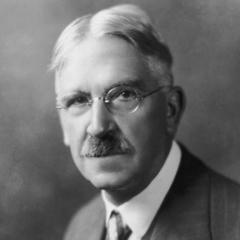
John Dewey
John Dewey

John Dewey was an American philosopher and educator, born on October 20, 1859, and died on June 1, 1952. He was a leading figure in the philosophy of pragmatism and had a profound impact on 20th-century education, philosophy, and the social sciences. more

You May Also Like

“What the public does is not to express its opinions but to align itself for or against a proposal. If that theory is accepted, we must abandon the notion that democratic government can be the direct expression of the will of the people. We must abandon the notion that the people govern. Instead, we must adopt the theory that, by their occasional mobilizations as a majority, people support or oppose the individuals who actually govern. We must say that the popular will does not direct continuously but that it intervenes occasionally.”

“No government by experts in which the masses do not have the chance to inform the experts as to their needs can be anything but an oligarchy managed in the interest of the few. And the enlightenment must proceed in ways which force the administrative specialists to take account of the needs. The world has suffered more from leaders and authorities than from the masses. The essential need ... is the improvement of the methods and conditions of debate, discussion and persuasion. That is the problem of the public.”

“Those who won our independence believed that the final end of the state was to make men free to develop their faculties... They valued liberty both as an end and as a means. They believed liberty to be the secret of happiness and courage to be the secret of liberty... that public discussion is a political duty; and that this should be a fundamental principle of the American government.”

“The best defence [for a democracy, for the public good] is aggressiveness, the aggressiveness of the involved citizen. We need to reassert that slow, time-consuming, inefficient, boring process that requires our involvement; it is called 'being a citizen.' The public good is not something that you can see. It is not static. It is a process. It is the process by which democratic civilizations build themselves.”