Quotessence
Home / Quotes / Quote by Arthur Conan Doyle

Quote by Arthur Conan Doyle

“It is brutal work, though not more brutal than that which goes onto supply every dinner-table in the country (Life on a Greenland Whaler, an article published in The Strand Magazine in january 1897)”

Quote by Arthur Conan Doyle

Author
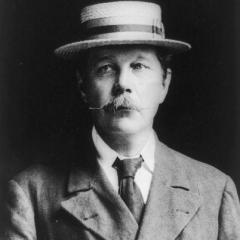
Arthur Conan Doyle
Arthur Conan Doyle

Arthur Conan Doyle, born on May 22, 1859 in Edinburgh, Scotland, was a renowned Scottish physician and writer. He is best known for his creation of the Sherlock Holmes series of detective novels, which have had a profound impact on the development of detective fiction and played a crucial role in shaping modern detective culture. more

You May Also Like

“His eyes, or rather the places where his eyes had been, were beheld. As strange misgrown masses gather in the knotholes of the noblest oaks when prostrate, so from the points which the whale's eyes had once occupied, now protruded blind bulbs, horribly pitiable to see. But pity there was none. For all his old age, and his one arm, and his blind eyes, he must die the death and be murdered, in order to light the gay bridals and other merry makings of men, and also to illuminate the solemn churches that preach unconditional inoffensiveness by all to all.”

“There is a blackout in media coverage of issues concerning whales and dolphins in Japan, with the exception of the government's viewpoint. It is simply amazing how little good information (and how much bad information) the public in Japan gets about the worldwide controversy over whaling and dolphin killing, all because the media bows to the wishes of the Japan Fisheries Agency.”

“So what drew them to whaling? Some might have been lured by what Baudelaire called the ‘profound and mysterious charm that arises from looking at a ship’; others, as Elizabeth Hardwick noted in her biography of Melville, ‘have come sulking away, address unknown, from howling creditors, accusing wives, alert policemen, beggary on shore’. Many greenhands were from farming families, some awaiting their inheritance, others, as younger sons, unlikely to come into anything. Runaway slaves were not uncommon aboard Yankee whalers: Nantucket’s Quaker population helped to secure berths for those in danger of being recaptured by bounty hunters.”

“The greenhands, by necessity, were taught the ropes at sea. The captain distributed them among the boats, so as not to slow its progress when they inevitably caught a crab with their oars, breaking the rhythm of the boat. From the stern, the mate called out ‘Break your backs!’ as each took an oar. It was best to be quick, for the ‘iron-fisted and iron-hearted officers’ often ‘beat their information in with anything that came to hand’.”

“White people love rock climbing almost more than they love camping. This is because the activity affords them the opportunity to be outside, to use a carabiner for something other than their keys, and to purchase a whole new set of expensive activity-specific clothing and accessories.”

“The point, of course, is that the people who spent days and sweated buckets could also have taken an aircraft to the summit if all they’d wanted was to absorb the view. It is the struggle that they crave. The sense of achievement is produced by the route to and from the peak, not by the peak itself. It is just the fold between the pages.” The avatar hesitated. It put its head a little to one side and narrowed its eyes. “How far do I have to take this analogy, Cr. Ziller?”.”