Quotessence
Home / Quotes / Quote by Benjamin Rush

Quote by Benjamin Rush

Work

Letters

A compilation of personal and professional exchanges that delve into the complexities of human connection and introspection. more

Author

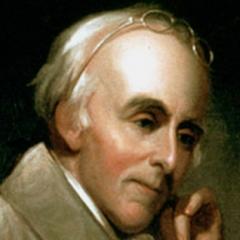
Benjamin Rush
Benjamin Rush

Benjamin Rush (December 24, 1745 - April 19, 1813) was an influential figure in the American Revolution, serving as a physician, politician, and educator. In 1797, appointed by President Adams, he became the treasurer of the U.S. Mint, a position he held until 1802. more

You May Also Like

“The business being thus closed . . . dined together and took a cordial leave of each other After which I returned to my lodgings, did some business with and received the papers from the secretary of the Convention, and retired to meditate on the momentous work which had been executed.”

“[T]he Constitution ought to be the standard of construction for the laws, and that wherever there is an evident opposition, the laws ought to give place to the Constitution. But this doctrine is not deducible from any circumstance peculiar to the plan of convention, but from the general theory of a limited Constitution.”

“The construction applied . . . to those parts of the Constitution of the United States which delegate Congress a power . . . ought not to be construed as themselves to give unlimited powers, nor a part to be so taken as to destroy the whole residue of that instrument.”

“[T]he true key for the construction of everything doubtful in a law is the intention of the law-makers. This is most safely gathered from the words, but may be sought also in extraneous circumstances provided they do not contradict the express words of the law.”

“The constitution of the United States is to receive a reasonable interpretation of its language, and its powers, keeping in view the objects and purposes, for which those powers were conferred. By a reasonable interpretation, we mean, that in case the words are susceptible of two different senses, the one strict, the other more enlarged, that should be adopted, which is most consonant with the apparent objects and intent of the Constitution.”