Quotessence
Home / Quotes / Quote by Alexander Hamilton

Quote by Alexander Hamilton

Work

The Essential Federalist: A New Reading of the Federalist Papers

This book delves into The Federalist Papers, providing a contemporary analysis of the original texts that shaped the United States Constitution. It examines the arguments and debates surrounding the creation of the federal government, offering readers a deeper understanding of the principles and values upon which the nation was built. more

Author
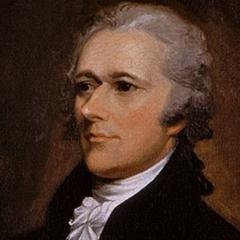
Alexander Hamilton
Alexander Hamilton

Alexander Hamilton was a Founding Father of the United States, born on January 11, 1757, and died on July 12, 1804. He played a crucial role in the American Revolutionary War and was instrumental in the drafting of the U.S. Constitution. As the first Secretary of the Treasury, Hamilton promoted fiscal stability and economic growth, establishing the First Bank of the United States and proposing solutions for federal debt. His ideas and policies had a profound impact on the early political and economic development of the United States. more

You May Also Like

“The construction applied . . . to those parts of the Constitution of the United States which delegate Congress a power . . . ought not to be construed as themselves to give unlimited powers, nor a part to be so taken as to destroy the whole residue of that instrument.”

“[T]he true key for the construction of everything doubtful in a law is the intention of the law-makers. This is most safely gathered from the words, but may be sought also in extraneous circumstances provided they do not contradict the express words of the law.”

“The constitution of the United States is to receive a reasonable interpretation of its language, and its powers, keeping in view the objects and purposes, for which those powers were conferred. By a reasonable interpretation, we mean, that in case the words are susceptible of two different senses, the one strict, the other more enlarged, that should be adopted, which is most consonant with the apparent objects and intent of the Constitution.”

“The Constitution on which our Union rests, shall be administered by me [as President] according to the safe and honest meaning contemplated by the plain understanding of the people of the United States at the time of its adoption - a meaning to be found in the explanations of those who advocated, not those who opposed it, and who opposed it merely lest the construction should be applied which they denounced as possible.”

“The best reason to be assigned, in this case, for not having made the Constitution more free from a charge of uncertainty in its meaning, is believed to be, that it was not suspected that any such charge would ever take place; and it appears that no such charge did take place, during the early period of the Constitution, when the meaning of its authors could be best ascertained, nor until many of the contemporary lights had in the lapse of time been extinguished. How often does it happen, that a notoriety of intention diminishes the caution against its being misunderstood or doubted!”

“It may not be improper, however, to remark two consequences, evidently flowing from an extension of the federal power to every subject falling within the idea of the "general welfare." One consequence must be, to enlarge the sphere of discretion allotted to the executive magistrate... The other consequence would be, that of an excessive augmentation of the offices, honors, and emoluments, depending on the executive will.”

“THE Constitution proposed by the convention may be considered under two general points of view. The FIRST relates to the sum or quantity of power which it vests in the government, including the restraints imposed on the States. The SECOND, to the particular structure of the government, and the distribution of this power among its branches.”

“there ought always to be a constitutional method of giving efficacy to constitutional provisions. What for instance would avail restrictions on the authority of the state legislatures, without some constitutional mode of enforcing the observance of them? . . . This power must either be a direct negative on the state laws, or an authority in the federal courts, to over-rule such as might be in manifest contravention of the articles of union.”