Quotessence
Home / Quotes / Quote by William O. Douglas

Quote by William O. Douglas

“The river, for example, is the living symbol of all the life it sustains or nourishes - fish, aquatic insects, water ouzels, otter, fisher, deer, elk, bear, and all other animals, including man, who are dependent on it or who enjoy it for its sight, its sound, or its life. The river as plaintiff speaks for the ecological unit of life that is part of it.”

Quote by William O. Douglas

Author
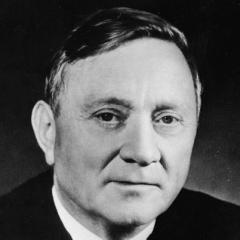
William O. Douglas
William O. Douglas

William O. Douglas was a former Associate Justice of the Supreme Court of the United States. Born on October 16, 1898, and passing away on January 19, 1980, he is renowned for his contributions to constitutional interpretation. During his tenure on the Supreme Court, Douglas advocated for liberal judgments, particularly in the areas of the First and Fifth Amendments, and had a profound impact on the American legal and judicial system. more

You May Also Like

“Modern man has no real "value" for the ocean. All he has is the most crass form of egoist, pragmatic value for it. He treats it as a "thing" in the worst possible sense, to exploit it for the "good" of man. The man who believes things are there only by chance cannot give things a real value. But for the Christian the value of a thing is not in itself autonomously, but because God made it.”

“One effect of benefit-cost analysis is to give any respectable engineer or economist a means for justifying almost any kind of project the national government wants to justify... Exclusive reliance on benefit-cost analysis has been one of the greatest threats to wise decisions in water development.”

“One of the signs of the imminent Apocalypse is the "bitterness of all waters," and anyone traveling through eastern Europe, the former Soviet Union and its satellites-everywhere that the command economy operated, with its callous disregard for anything but narrow-focused abstract principle-could be forgiven for thinking that the Apocalypse was no longer imminent but in full cry. There's hardly a river, stream, or brook that isn't contaminated with the runoff from human misuse, whether industrial effluents, agricultural pesticides and herbicides, or worse.”

“Perhaps one of the most meaningful ways to sense the impact of the environmental crisis is to confront the question which is always asked about Lake Erie: how can we restore it? I believe the only valid answer is that no one knows. For it should be clear that even if overnight all of the pollutants now pouring into Lake Erie were stopped, there would still remain the problem of the accumulated mass of pollutants in the lake bottom.”

“Although the United States has made tremendous progress cleaning up its water by removing billions of pounds of pollutants and doubling the number of waterways safe for fishing and swimming, a majority of Americans live within 10 miles of a polluted lake, river, stream or coastal area.”

“The good news about fresh water is that, even after accounting for the larger volume of water that is unavailable to people from the hydrologic cycle, there is enough on a global scale to support current and anticipated populations on a sustainable basis... Three essential goals are dependable and safe supplies for people, protection and management of the environmental systems through which water moves, and efficient water use. Meeting these goals will require that fresh water not continue to be treated as a free good or as the principal means for disposing of human and industrial wastes.”

“We can at least see that the question is asked, and asked on the basis of a clear recognition that there is no way of manipulating our environment that is without cost or consequence - and thus also of a recognition that we are inextricably bound up with the destiny of our world. There is no guarantee that the world we live in will "tolerate" us indefinitely if we prove ourselves unable to live within its constraints.”

“The wrecking ball is characteristic of our way with materials. We 'cannot afford' to log a forest selectively, to mine without destroying topography, or to farm without catastrophic soil erosion. A production-oriented economy can indeed live in this way, but only so long as production lasts.”