Quotessence
Home / Quotes / Quote by Jean-Paul Sartre

Quote by Jean-Paul Sartre

“But for me there is neither Monday nor Sunday: there are days which pass in disorder, and then, sudden lightning like this one. Nothing has changed and yet everything is different. I can't describe it, it's like the Nausea and yet it's just the opposite: at last an adventure happens to me and when I question myself I see that it happens that I am myself and that I am here; I am the one who splits in the night, I am as happy as the hero of a novel.”

Quote by Jean-Paul Sartre

Book:Nausea

Work

Nausea

In this seminal work, the protagonist grapples with the meaninglessness of existence and the absurdity of everyday life, leading to a profound exploration of the human condition. more

Author

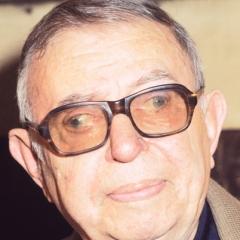
Jean-Paul Sartre
Jean-Paul Sartre

Jean-Paul Sartre was a French philosopher, writer, and playwright, born on June 21, 1905, and died on April 15, 1980. He is considered one of the most important philosophers of the 20th century, renowned for his existentialist philosophy. Sartre's works spanned across philosophy, literature, and drama, and had a profound impact on later generations. more

You May Also Like

“I see many people die because they judge that life is not worth living. I see others paradoxically getting killed for the ideas or illusions that give them a reason for living (what is called a reason for living is also an excellent reason for dying). I therefore conclude that the meaning of life is the most urgent of questions.”

“Freedom is only to be found where there is burden to be shouldered. In creative achievements this burden always represents an imperative and a need that weighs heavily upon man’s mood, so that he comes to be in a mood of melancholy. All creative action resides in a mood of melancholy, whether we are clearly aware of the fact or not, whether we speak at length about it or not. All creative action resides in a mood of melancholy, but this is not to say that everyone in a melancholy mood is creative.”

“They were still in the happier stage of love. They were full of brave illusions about each other, tremendous illusions, so that the communion of self with self seemed to be on a plane where no other human relations mattered. They both seemed to have arrived there with an extraordinary innocence as though a series of pure accidents had driven them together, so many accidents that at last they were forced to conclude that they were for each other. They had arrived with clean hands, or so it seemed, after no traffic with the merely curious and clandestine.”