Quotessence
Home / Quotes / Quote by Noam Chomsky

Quote by Noam Chomsky

“Under the rules of the Western-run international economy, investors make loans to third world tyrannies, and since the loans carry considerable risk, make high profits. Suppose the borrower defaults. In a capitalist economy, the lenders would incur the loss. But existing capitalism really functions quite differently. If the borrowers cannot pay the debts, then the IMF steps in to guarantee that lenders and investors are protected. The debt is transferred to the poor population of the debtor country, who never borrowed the money in the first place and gained little if anything from it. The method is called “structural adjustment.” And taxpayers in the rich country, who also gained nothing from the loans, sustain the IMF through their taxes. These doctrines do not derive from economic theory; they merely reflect the distribution of decision-making power.”

Quote by Noam Chomsky

Work

Hopes and Prospects

This book delves into various aspects of societal, economic, and environmental trends, offering insights into the prospects of humanity's future. more

Author
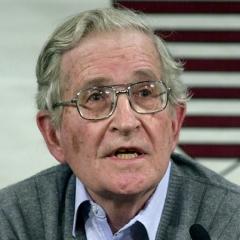
Noam Chomsky
Noam Chomsky

Noam Chomsky, born on December 7, 1928, is a renowned linguist from the United States. His research in generative grammar and transformational grammar has had a profound impact on modern linguistics. Chomsky's academic achievements extend beyond linguistics, as he is also an active political commentator and philosopher, known for his unique perspective and profound insights. more

You May Also Like

“Peace, Inc., is sometimes as worrying and War, Inc. It's a way of managing public anger. We're all being managed, and we don't even know it. The IMF and the World Bank, the most opaque and secretive entities, put millions into NGOs who fight against "corruption" and for "transparency." They want the Rule of Law--as long as they make the laws. They want transparency in order to standardise a situation, so that global capital can flow without any impediment. Cage the People, Free the Money. The only thing that is allowed to move freely--unimpeded--around the world today is money, capital.”

“According to Robert S. McNamara, former president of the World Bank, without firm action to further reduce the population growth rate, world population will not stabilize below eleven billion. "At the national level," states McNamara, "rapid population growth translates into a steadily worsening employment future, massive city growth, pressure on food supplies, degradation of the environment, an increase in the number of 'absolute poor,' and a stimulus to authoritarian government.”

“This book is an essay in what is derogatorily called "literary economics," as opposed to mathematical economics, econometrics, or (embracing them both) the "new economic history." A man does what he can, and in the more elegant - one is tempted to say "fancier" - techniques I am, as one who received his formation in the 1930s, untutored. A colleague has offered to provide a mathematical model to decorate the work. It might be useful to some readers, but not to me. Catastrophe mathematics, dealing with such events as falling off a height, is a new branch of the discipline, I am told, which has yet to demonstrate its rigor or usefulness. I had better wait. Econometricians among my friends tell me that rare events such as panics cannot be dealt with by the normal techniques of regression, but have to be introduced exogenously as "dummy variables." The real choice open to me was whether to follow relatively simple statistical procedures, with an abundance of charts and tables, or not. In the event, I decided against it. For those who yearn for numbers, standard series on bank reserves, foreign trade, commodity prices, money supply, security prices, rate of interest, and the like are fairly readily available in the historical statistics.”

“As Thorstein Veblen correctly surmised over a century ago, the failure of economics to become an evolutionary science is the product of the optimizing framework of the underlying paradigm, which is inherently antithetical to the process of evolutionary change. This is the primary reason why the neoclassical mantra that the economy must be perceived as the outcome of the decisions of utility-maximizing individuals must be squarely rejected.”

“An essential pedagogic step here is to relegate the teaching of mathematical methods in economics to mathematics departments. Any mathematical training in economics, if it occurs at all, should come after students have at the very least completed course work in basic calculus, algebra and differential equations (the last being one about which most economists are woefully ignorant). This simultaneously explains why neoclassical economists obsess too much about proofs and why non-neoclassical economists, like those in the Circuit School, experience such difficulties in translating excellent verbal ideas about credit creation into coherent dynamic models of a monetary production economy.”