Quotessence
Home / Quotes / Quote by Iris Murdoch

Quote by Iris Murdoch

Work

The Sacred and Profane Love Machine

This book delves into complex relationships and the intricate tapestry of human emotions, offering a rich exploration of the sacred and profane aspects of love. more

Author
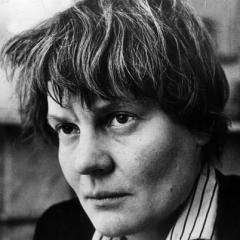
Iris Murdoch
Iris Murdoch

Iris Murdoch was an Irish-Canadian philosopher and author, born on July 15, 1919, in Dublin, Ireland, and passed away on February 8, 1999. She is celebrated for her philosophical novels that intertwine moral and ethical dilemmas with complex narratives. Murdoch's work has left a lasting impact on the literary world, particularly in the latter half of the 20th century. more

You May Also Like

“I was lying on a soft bed of fallen leaves, their crunch unmistakable beneath me as I twisted and writhed. The air was cool, but he was beside me, keeping me warm. He was as familiar to me as my own breathing, yet I was aware that his was not a simple human touch. His presence was less dense than the human body's but more powerful, and able to engulf me. I took in the ambrosia of his hot scent- wood, leather, and ancient spices- earthy, in contrast to the feel of his being. I opened my eyes and saw that we were lying in a grove of trees with golden leaves beneath unfamiliar stars that blazed across an immense velvet sky. The wind tossed about a single glistening leaf, which rose and fell at the air's will. I watched it dance with the breeze as my lover flooded my senses. Eventually, it fluttered beside us and fell to the earth.”

“Durante toda mi vida he entendido el amor como una especie de esclavitud consentida. Pero esto no es así: la libertad sólo existe cuando existe el amor. Quien se entrega totalmente, quien se siente libre, ama al máximo. Y quien ama al máximo, se siente libre. Pero en el amor, cada uno de nosotros es responsable por lo que siente, y no puede culpar al otro por eso. Nadie pierde a nadie porque nadie posee a nadie. Y esta es la verdadera experiencia de la libertad: Tener lo más importante del mundo sin poseerlo.”

“The more time he spent out of the office and in the public, the more he had to deal with asshats and dipshits. Dale wished the general public would take up hobbies that would benefit him, like walking off cliffs, pressing themselves into meat grinders, diving into wood chippers, or anything that kept them at home so he wouldn’t have to deal with them.”

“Each generation exercises power over its successors: and each, in so far as it modifies the environment bequeathed to it and rebels against tradition, resists and limits the power of its predecessors. This modifies the picture which is sometimes painted of a progressive emancipation from tradition and a progressive control of natural processes resulting in a continual increase of human power. In reality, of course, if any one age really attains, by eugenics and scientific education, the power to make its descendants what it pleases, all men who live after it are the patients of that power. They are weaker, not stronger: for though we may have put wonderful machines in their hands we have pre-ordained how they are to use them.”

“Ideas like cosmic justice, collective hope, and national redemption had no meaning for me. The truth was in the everything that came after atheism, after the amorality of the universe is taken not as a problem but as a given. It was then that I was freed from considering my own morality away from the cosmic and the abstract. Life was short, and death undefeated. So I loved hard, since I would not love for long.”