Quotessence
Home / Quotes / Quote by Aldo Leopold

Quote by Aldo Leopold

“By and large, our present problem is one of attitudes and implements. We are remodeling the Alhambra with a steam-shovel, and we are proud of our yardage. We shall hardly relinquish the shovel, which after all has many good points, but we are in need of gentler and more objective criteria for its successful use”

Quote by Aldo Leopold

Author
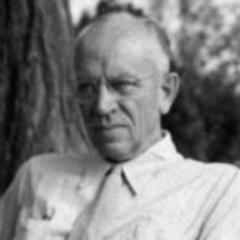
Aldo Leopold
Aldo Leopold

Aldo Leopold was an American author, philosopher, conservationist, and environmentalist. He is best known for his book 'A Sand County Almanac', which is considered a foundational text in environmental ethics and wildlife management. Leopold was born on January 11, 1887, and passed away on April 21, 1948. more

You May Also Like

“For us, the possibility of kindly use is weighted with problems. In the first place, this is not ultimately an organization or institutional solution. Institutional solutions tend to narrow and simplify as they approach action. A large number of people can act together only by defining the point or the line on which their various interests converge. Organizations tend to move toward single objectives -- a ruling, a vote, a law -- and they find it relatively simple to cohere under acronyms and slogans. But kindly use is a concept that of necessity broadens, becoming more complex and diverse, as it approaches action. The land is too various in its kinds, climates, conditions, declivities, aspects, and histories to conform to any generalized understanding or to prosper under generalized treatment. The use of land cannot be both general and kindly -- just as the forms of good manners, generally applied (applied, that is, without consideration of differences), are experienced as indifference, bad manners. To treat every field, or every part of every field, with the same consideration is not farming but industry. Kindly use depends upon intimate knowledge, the most sensitive responsiveness and responsibility. As knowledge (hence, use) is generalized, essential values are destroyed. As the householder evolves into a consumer, the farm evolves into a factory -- with results that are potentially calamitous for both.”

“The fallacy the economic determinists have tied around our collective neck, and which we now need to cast off, is the belief that economics determines all land-use. This is simply not true. An innumerable host of actions and attitudes, comprising perhaps the bulk of all land relations, is determined by the land-users’ tastes and predilections, rather than by his purse.”

“The increasingly one-dimensional use of land stands in stark contrast to the mixed arable and pastoral economies of the bailtean which, in turn, sustained socially complex communities. These township populations nurtured knowledge production systems that enabled mixed land management strategies. This was underpinned by communal, rule-based approaches to foreshores, grazing, and fuel assets which were taken to be common pool resources. Local resources could then be exploited through a consciously integrated and diverse set of micro-economies.”

“Farmers and ranchers make up just 1 percent of the U.S. population but manage two-thirds of the nation's land; agriculture has greater impacts on water, land and terrestrial biodiversity than any other human enterprise....Half of Earth's ice-free land is in pasture or farms. Crops now cover an area the size of South America and livestock graze an expanse as big as Africa; together they use 70 percent of all fresh water. Fishermen have an equally enormous impact, harvesting 90 million metric tons of fish annually-equivalent, as author Paul Greenberg calculates, to pulling the human weight of China out of the sea every year.”

“Cult (totalistic type): a group or movement exhibiting a great or excessive devotion or dedication to some person, idea, or thing and employing unethically manipulative techniques of persuasion and control (e.g., isolation from former friends and family, debilitation, use of special methods to heighten suggestibility and subservience, powerful group pressure, information management, suspension of individuality or critical judgement, promotion of total dependency on the group and fear of leaving it, etc) designed to advance the goals of the group's leaders, to the actual or possible detriment of members, their families, or the community.”

“The lens can act in many different ways and lenses can be stacked on top of each other in order to produce varying types of views. Take the fish-eye lens as an example. The glass on the lens is shaped in a certain way in order for the light to enter and produce a certain kind of distorted view. We all are born with a lens, but usually we get to kind of start at ground zero in the process of beginning to understand, use, and interpret what this physical reality is. As our eyes open and we start to interface with this new reality, we form connections and synapses within our brain for interpretation and use of this new tool that we have. And much of this develops through the guidance or non-guidance of those caring for us. So much starts to become ingrained, and even in some cases we can borrow other people’s lenses in order to feel safe in the world. Sometimes the layers and layers can become quite complex. How many of you feel that anything you come in contact with gets to be translated through a menagerie of different thoughts, ideas, and histories before it fully gets seen?”