Quotessence
Home / Quotes / Quote by Lucretius

Quote by Lucretius

“For out of doubt In these affairs 'tis each man's will itself That gives the start, and hence throughout our limbs Incipient motions are diffused.”

Quote by Lucretius

Work

The Way Things Are

This work addresses fundamental questions about the structure of reality and human understanding. It considers how individuals construct meaning from their experiences and the relationship between perception and truth. The text engages with longstanding debates in metaphysics and epistemology, drawing connections between abstract philosophical concepts and everyday life. Readers encounter discussions on how cultural, historical, and personal factors shape one's comprehension of what exists and how things function in the observable world. more
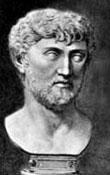
Author

Lucretius
Lucretius

Lucretius (99 BC - 55 BC) was a renowned Greek Roman poet, hailed as the peak of Greek Roman philosophical poetry. His work 'On the Nature of Things' presented the natural philosophical ideas of the Greek philosopher Democritus in poetic form, which had a profound impact on later generations. more

You May Also Like

“And since the mind is of a man one part, Which in one fixed place remains, like ears, And eyes, and every sense which pilots life; And just as hand, or eye, or nose, apart, Severed from us, can neither feel nor be, But in the least of time is left to rot, Thus mind alone can never be, without The body and the man himself, which seems, As 'twere the vessel of the same- or aught Whate'er thou'lt feign as yet more closely joined: Since body cleaves to mind by surest bonds.”

“The idea of men's receiving an intimation of their connection with the world around them through an immediate feeling which is from the outset directed to that purpose sounds so strange and fits in so badly with the fabric of our psychology that one is justified in attempting to discover a psycho-analytic - that is, a genetic - explanation of such a feeling.”

“Pathology has made us acquainted with a great number of states in which the boundary lines between the ego and the external world become uncertain or in which they are actually drawn incorrectly. There are cases in which parts of a person's own body, even portions of his own mental life - his perceptions, thoughts and feelings -, appear alien to him and as not belonging to his ego; there are other cases in which he ascribes to the external world things that clearly originate in his own ego and that ought to be acknowledged by it.”

“The assumption that everything past is preserved holds good even in mental life only on condition that the organ of the mind has remained intact and that its tissues have not been damaged by trauma or inflammation. But destructive influences which can be compared to causes of illness like these are never lacking in the history of a city, even if it has had a less chequered past than Rome, and even if, like London, it has hardly ever suffered from the visitations of an enemy.”