Quotessence
Home / Quotes / Quote by Sigmund Freud

Quote by Sigmund Freud

“The idea of men's receiving an intimation of their connection with the world around them through an immediate feeling which is from the outset directed to that purpose sounds so strange and fits in so badly with the fabric of our psychology that one is justified in attempting to discover a psycho-analytic - that is, a genetic - explanation of such a feeling.”

Quote by Sigmund Freud

Work

The standard edition of the complete psychological works of Sigmund Freud

This book is a seminal work in the field of psychology, compiling the extensive writings of Sigmund Freud, a pioneer in the development of psychoanalysis. It includes his seminal theories on the unconscious mind, dreams, and the structure of the psyche. more

Author
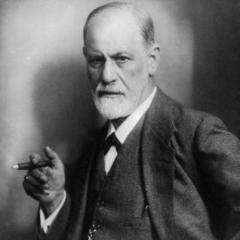
Sigmund Freud
Sigmund Freud

Sigmund Freud, born on May 6, 1856, in Moravia, and died on September 23, 1939, in London, was an Austrian neurologist and the founder of psychoanalysis. Known as the father of modern psychology, Freud made significant contributions to the understanding of human psychology, introducing concepts such as the unconscious mind, dream analysis, and sexual theory. more

You May Also Like

“Pathology has made us acquainted with a great number of states in which the boundary lines between the ego and the external world become uncertain or in which they are actually drawn incorrectly. There are cases in which parts of a person's own body, even portions of his own mental life - his perceptions, thoughts and feelings -, appear alien to him and as not belonging to his ego; there are other cases in which he ascribes to the external world things that clearly originate in his own ego and that ought to be acknowledged by it.”

“The assumption that everything past is preserved holds good even in mental life only on condition that the organ of the mind has remained intact and that its tissues have not been damaged by trauma or inflammation. But destructive influences which can be compared to causes of illness like these are never lacking in the history of a city, even if it has had a less chequered past than Rome, and even if, like London, it has hardly ever suffered from the visitations of an enemy.”

“What decides the purpose of life is simply the programme of the pleasure principle. This principle dominates the operation of the mental apparatus from the start. There can be no doubt about its efficacy, and yet its programme is at loggerheads with the whole world, with the macrocosm as much as with the microcosm.”

“It is no wonder if, under the pressure of these possibilities of suffering, men are accustomed to moderate their claims to happiness - just as the pleasure principle itself, indeed, under the influence of the external world, changed into the more modest reality principle -, if a man thinks himself happy merely to have escaped unhappiness or to have survived his suffering, and if in general the task of avoiding suffering pushes that of obtaining pleasure into the background.”

“Another technique for fending off suffering is the employment of the displacements of libido which our mental apparatus permits of and through which its function gains so much in flexibility. The task here is that of shifting the instinctual aims in such a way that they cannot come up against frustration from the external world.”

“The division of the psychical into what is conscious and what is unconscious is the fundamental premise of psycho-analysis; and it alone makes it possible for psycho-analysis to understand the pathological processes in mental life, which are as common as they are important, and to find a place for them in the framework of science.”

“A state of consciousness is characteristically very transitory; an idea that is conscious now is no longer so a moment later, although it can become so again under certain conditions that are easily brought about.”