Quotessence
Home / Quotes / Quote by Robert F. Kennedy, Jr.

Quote by Robert F. Kennedy, Jr.

“Industrial agriculture now accounts for over half of America's water pollution. Two years ago, Pfiesteria outbreaks connected with wastes from industrial chicken factories forced the closure of two major tributaries of the Chesapeake and threatened Maryland's vital shellfish industry. Tyson Foods has polluted half of all streams in northwestern Arkansas with so much fecal bacteria that swimming is prohibited. Drugs and hormones needed to keep confined animals alive and growing are mainly excreted with the wastes and saturate local waterways.”

Quote by Robert F. Kennedy, Jr.

Author
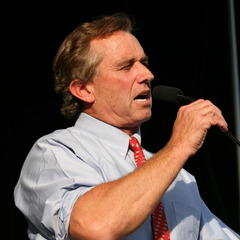
Robert F. Kennedy, Jr.

Robert F. Kennedy Jr., born January 17, 1954, is an American environmental lawyer, activist, and radio host. He is the son of former U.S. Attorney General Robert F. Kennedy and nephew of President John F. Kennedy. He founded Waterkeeper Alliance, a global environmental organization, and hosts a political commentary show on Sirius XM radio. He gained prominence through his environmental advocacy work and has become a controversial figure due to his political views. more

You May Also Like

“It is a fact that the entire Kentucky River system, which the central part of the state complacently depends upon for its future water, is deteriorating rapidly because of strip mining, because of bad farming, because of industrial and agricultural pollutants, because of urban sewage. It is deteriorating, that is to say, because almost nobody cares, or cares to know, where water comes from, so long as it keeps coming.”

“The assumption is that people so ignorant and thoughtless and silly and greedy may simply call upon the Army Corps of Engineers in order to receive a clean and abundant supply of water from reservoirs in the mountains. A much likelier outcome is that they will be drinking an ever stronger mixture of sewage and mine acid and mud and cropspray and various other defecations of the industrial paradise.”

“The procedure has a strange Alice-in-Wonderland quality. The reservoir was created as a public water supply, yet the community, probably unconsulted about the sportsmen's project, is forced either to drink water containing poisonous residues or to pay our tax money for treatment of the water to remove the poisons - treatments that are by no means foolproof.”

“Let me say this before rain becomes a utility that they can plan and distribute for money. By "they" I mean the people who cannot understand that rain is a festival, who do not appreciate its gratuity, who think that what has no price has no value, that what cannot be sold is not real, so that the only way to make something actual is to place it on the market. The time will come when they will sell you even your rain. At the moment it is still free, and I am in it. I celebrate its gratuity and its meaninglessness.”

“Man's history is woven into waterways, for not only did he live beside them, but he used them as highways for hunting, exploration, and trade. Water assured his welfare, its absence meant migration or death, its constancy nourished his spirit. A mountain, a desert, or a great forest might serve his need of strength, but water reflects his inner needs.”

“The problem with water, though, is that the shortfalls don't show up until the very end. You can go on pumping unsustainably until the day you run out. Then all you have is the recharge flow, which comes from precipitation. This is not decades away, this is years away. We're already seeing huge shortages in China, where the Yellow River runs dry for part of each year. The Yellow River is the cradle of Chinese civilization. It first failed to reach the sea in 1972, and since 1985 it's run dry for part of each year. For 1997 it was dry for 226 days.”