Quotessence
Home / Quotes / Quote by John Steinbeck

Quote by John Steinbeck

Work

The Pearl

This novella, set in the Mexican gulf coast, follows the story of a poor fisherman who discovers a magnificent pearl. The discovery brings him wealth and ambition, but also leads to tragedy and moral dilemmas. The story delves into the corrupting influence of sudden wealth and the consequences of human desires. more
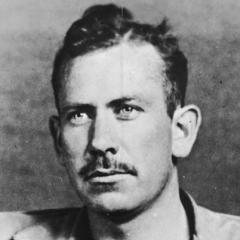
Author

John Steinbeck
John Steinbeck

John Steinbeck was an American author renowned for his profound depiction of American society and the lives of farmers. His works often explore themes of poverty, social injustice, and human nature. Steinbeck was awarded the Nobel Prize in Literature in 1962 for his significant contribution to American literature. more

You May Also Like

“Christmas is the great leveler. For we might sit in lofty positions of prestige and power, or we might sit huddled in some back alley with nothing but a few scraps of food and a handful of tattered garments. We can steer nations or know nothing of nations or steering. We can possess the assorted holdings of a vast portfolio, or we can hold nothing but that which is in our hands. Despite our station in life, whether it be lofty or lowly, the need for salvation escapes none of us, is offered to all of us, and will determine the destiny of each of us.”

“I could see the road ahead of me. I was poor and I was going to stay poor. But I didn't particularly want money. I didn't know what I wanted. Yes, I did. I wanted someplace to hide out, someplace where one didn't have to do anything. The thought of being something didn't only appall me, it sickened me. The thought of being a lawyer or a councilman or an engineer, anything like that, seemed impossible to me. To get married, to have children, to get trapped in the family structure. To go someplace to work every day and to return. It was impossible. To do things, simple things, to be part of family picnics, Christmas, the 4th of July, Labor, Mother's Day . . . was a man born just to endure those things and then die? I would rather be a dishwasher, return alone to a tiny room and drink myself to sleep. My father had a master plan. He told me, "My son, each man during his lifetime should buy a house. Finally he dies and leaves that house to his son. Then his son gets his own house and dies, leaves both houses to his son. That's two houses. That son gets his own house, that's three houses . . ." The family structure. Victory over adversity through the family. He believed in it. Take the family, mix with God and Country, add the ten-hour day and you had what was needed. I looked at my father, at his hands, his face, his eyebrows, and I knew that this man had nothing to do with me. He was a stranger. My mother was non-existent. I was cursed. Looking at my father I saw nothing but indecent dullness. Worse, he was even more afraid to fail than most others. Centuries of peasant blood and peasant training. The Chinaski bloodline had been thinned by a series of peasant-servants who had surrendered their real lives for fractional and illusionary gains. Not a man in line who said, "I don't want a house, I want a thousand houses, now!" He had sent me to that rich high school hoping that the ruler's attitude would rub off on me as I watched the rich boys screech up in their cream-colored coupes and pick up the girls in bright dresses. Instead I learned that the poor usually stay poor. That the young rich smell the stink of the poor and learn to find it a bit amusing. They had to laugh, otherwise it would be too terrifying. They'd learned that, through the centuries. I would never forgive the girls for getting into those cream-colored coupes with the laughing boys. They couldn't help it, of course, yet you always think, maybe . . . But no, there weren't any maybes. Wealth meant victory and victory was the only reality. What woman chooses to live with a dishwasher?”