“Detection is, or ought to be, an exact science and should be treated in the same cold and unemotional manner. You have attempted to tinge it with romanticism, which produces much the same effect as if you worked a love-story ... Some facts should be suppressed, or, at least, a just sense of proportion should be observed in treating them. The only point in the case which deserved mention was the curious analytical reasoning from effects to causes, by which I succeeded in unravelling it.'' —Sherlock Holmes on John Watson's "pamphlet", "A Study in Scarlet".”
Quote by Arthur Conan Doyle
Author
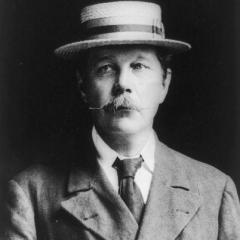
Arthur Conan Doyle
Arthur Conan Doyle, born on May 22, 1859 in Edinburgh, Scotland, was a renowned Scottish physician and writer. He is best known for his creation of the Sherlock Holmes series of detective novels, which have had a profound impact on the development of detective fiction and played a crucial role in shaping modern detective culture. more
You May Also Like
“Reason is our soul's left hand, Faith her right, By these we reach divinity”
Source: Selected Poetry
Source: Blaine Josten's Jane Austen's Pride and Prejudice (Annotated)
Source: To the Lighthouse
Source: The Teaching of Epictetus: Being the Encheiridion of Epictetus with Selections from the Dissertations and Fragments
“Most people live for love and admiration. But it is by love and admiration that we should live.”
Source: The Complete Works of Oscar Wilde: De profundis,
Source: The Collected Works of Oscar Wilde