Quotessence
Home / Quotes / Quote by John Dewey

Quote by John Dewey

Work

The Middle Works, 1899-1924

This volume includes a selection of essays, lectures, and other writings that span the middle period of the author's career, showcasing their intellectual development and exploration of various philosophical themes. more

Author
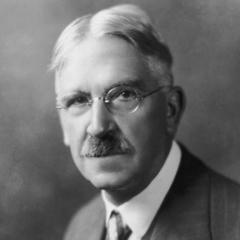
John Dewey
John Dewey

John Dewey was an American philosopher and educator, born on October 20, 1859, and died on June 1, 1952. He was a leading figure in the philosophy of pragmatism and had a profound impact on 20th-century education, philosophy, and the social sciences. more

You May Also Like

“The human understanding is moved by those things most which strike and enter the mind simultaneously and suddenly, and so fill the imagination; and then it feigns and supposes all other things to be somehow, though it cannot see how, similar to those few things by which it is surrounded.”

“The mind is a vagrant thing ... Thinking is not analogous to a person working in a laboratory who invents something on company time. Answering criticism that the book for which he won a Pulitzer Prize was written in the years he had been employed at the Smithsonian. He specified that did not write on the premises there, but only at home outside of working hours.”

“The popularisation of scientific doctrines is producing as great an alteration in the mental state of society as the material applications of science are effecting in its outward life. Such indeed is the respect paid to science, that the most absurd opinions may become current, provided they are expressed in language, the sound of which recals [sic] some well-known scientific phrase.”

“To us ... the only acceptable point of view appears to be the one that recognizes both sides of reality-the quantitative and the qualitative, the physical and the psychical-as compatible with each other, and can embrace them simultaneously ... It would be most satisfactory of all if physis and psyche (i.e., matter and mind) could be seen as complementary aspects of the same reality.”

“We are at our human finest, dancing with our minds, when there are more choices than two. Sometimes there are ten, even twenty different ways to go, all but one bound to be wrong, and the richness of the selection in such situations can lift us onto totally new ground.”

“We are ... led to a somewhat vague distinction between what we may call "hard" data and "soft" data. This distinction is a matter of degree, and must not be pressed; but if not taken too seriously it may help to make the situation clear. I mean by "hard" data those which resist the solvent influence of critical reflection, and by "soft" data those which, under the operation of this process, become to our minds more or less doubtful.”