“"What is truth?" said jesting Pilate, and would not stay for an answer. Pilate was in advance of his time. For "truth" itself is an abstract noun, a camel, that is, of a logical construction, which cannot get past the eye even of a grammarian. We approach it cap and categories in hand: we ask ourselves whether Truth is a substance (the Truth, the Body of Knowledge), or a quality (something like the colour red, inhering in truths), or a relation ("correspondence"). But philosophers should take something more nearly their own size to strain at. What needs discussing rather is the use, or certain uses, of the word "true." In vino, possibly, "veritas," but in a sober symposium "verum."”
Quote by J. L. Austin
Author
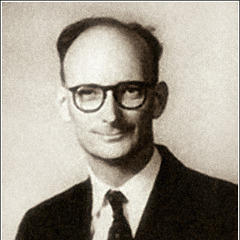
J. L. Austin
J. L. Austin (John Langshaw Austin, March 26, 1911 – February 8, 1960) was a prominent British philosopher and a leading figure in ordinary language philosophy. He studied and taught at Oxford University, where he developed his influential theory of speech acts, arguing that language is not merely descriptive but also performative. His seminal work, How to Do Things with Words, introduced the concepts of locutionary, illocutionary, and perlocutionary acts, and distinguished between performative and constative utterances. Austin's meticulous analysis of everyday language challenged traditional philosophical approaches and had a lasting impact on linguistics, philosophy of language, law, and literary theory. He died of lung cancer at age 48. more