Quotessence
Home / Quotes / Quote by Alexander Hamilton

Quote by Alexander Hamilton

Work

The Federalist, on the New Constitution, Written in the Year 1788

Composed by Alexander Hamilton, James Madison, and John Jay, this collection of essays advocates for the ratification of the U.S. Constitution, offering insights into the structure and function of the federal government. more

Author
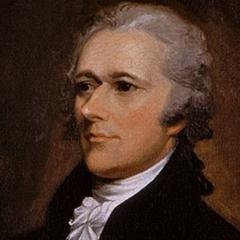
Alexander Hamilton
Alexander Hamilton

Alexander Hamilton was a Founding Father of the United States, born on January 11, 1757, and died on July 12, 1804. He played a crucial role in the American Revolutionary War and was instrumental in the drafting of the U.S. Constitution. As the first Secretary of the Treasury, Hamilton promoted fiscal stability and economic growth, establishing the First Bank of the United States and proposing solutions for federal debt. His ideas and policies had a profound impact on the early political and economic development of the United States. more

You May Also Like

“There was a time when we were told . . . that a sense of common interest would preside over the conduct of the respective members...This language at the present day would appear as wild as that great part of what we now hear from the same quarter will be thought, when we shall have received further lessons from that best oracle of wisdom, experience.”

“Hitherto my observations have only aimed at a vindication of the provision in question, on the ground of theoretic propriety . . . . But there remains to be mentioned a positive advantage . . . I allude to the circumstance of uniformity in the time of elections for the House of Representatives. It is more than possible, that this uniformity may be found by experience to be of great importance to the public welfare; both as a security against the perpetuation of the same spirit in the body; and as a cure for the diseases of faction.”

“What concerns all, should be considered by all; and individuals may injure a whole society, by not declaring their sentiments. It is therefore not only their right, but their duty, to declare them.”

“[A]lthough a republican government is slow to move, yet when once in motion, its momentum becomes irresistible.”

“If, then, the control of the people over the organs of their government be the measure of its republicanism, and I confess I know no other measure, it must be agreed that our governments have much less of republicanism than ought to have been expected; in other words, that the people have less regular control over their agents, than their rights and their interests require.”

“If we resort for a criterion to the different principles on which different forms of government are established, we may define a republic to be, or at least may bestow that name on, a government which derives all its powers directly or indirectly from the great body of the people, and is administered by persons holding their offices during pleasure for a limited period, or during good behavior.”

“A republic, by which I mean a government in which the scheme of representation takes place, opens a different prospect and promises the cure for which we are seeking.”

“The regular distribution of power into distinct departments; the introduction of legislative balances and checks; the institution of courts composed of judges holding their offices during good behavior; the representation of the people in the legislature by deputies of their own election . . . They are means, and powerful means, by which the excellences of republican government may be retained and its imperfections lessened or avoided.”

“The unity of government which constitutes you one people is also now dear to you. It is justly so, for it is a main pillar in the edifice of your real independence, the support of your tranquility at home, your peace abroad, of your safety, of your prosperity, of that very liberty which you so highly prize.”

“The genius of Republican liberty, seems to demand on one side, not only that all power should be derived from the people; but, that those entrusted with it should be kept in dependence on the people, by a short duration of their appointments; and, that, even during this short period, the trust should be placed not in a few, but in a number of hands.”