Quotessence
Home / Quotes / Quote by Edward McKendree Bounds

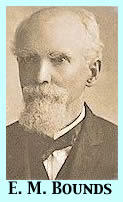
Quote by Edward McKendree Bounds

“Preachers are not sermon makers, but men makers and saint makers, and he only is well-trained for this business who has made himself a man and a saint. It is not great talents nor great learning nor great preachers that God needs, but men great in holiness, great in faith, great in love, great in fidelity, great for God - men always preaching by holy sermons in the pulpit, by holy lives out of it. These can mold a generation for God.”

Quote by Edward McKendree Bounds

Work

Power Through Prayer

This book explores the practice of prayer as a means to spiritual growth and empowerment, offering insights and techniques for incorporating prayer into one's routine. more

Author

Edward McKendree Bounds

Edward McKendree Bounds was an American author known for his spiritual writings. His works primarily focused on personal growth, spirituality, and moral修养. Bounds' writing style was deeply influenced by Christian thought, and his books and lectures had a profound impact on many readers. more

You May Also Like

“For Jews, the Messiah has never come; for Christians, He has come but once; for modern man, He appears and disappears with increasing rapidity. The saviors of modern man, the "scientists" who promise salvation through the "discoveries" of ethology and sociology, psychology and psychiatry, and all the other bogus religions, issue forth periodically, as if selected by some Messiah-of-the-Month Club.”

“If, nevertheless, textbooks of pharmacology legitimately contain a chapter on drug abuse and drug addiction, then, by the same token, textbooks of gynecology and urology should contain a chapter on prostitution; textbooks of physiology, a chapter on perversion; textbooks of genetics, a chapter on the racial inferiority of Jews and Negroes.”

“The great shift... is the movement away from the value-laden languages of... the "humanities," and toward the ostensibly value-neutral languages of the "sciences." This attempt to escape from, or to deny, valuation is... especially important in psychology... and the so-called social sciences. Indeed, one could go so far as to say that the specialized languages of these disciplines serve virtually no other purpose than to conceal valuation behind an ostensibly scientific and therefore nonvaluational semantic screen.”

“As the dominant social ethic changed from a religious to a secular one, the problem of heresy disappeared, and the problem of madness arose and became of great social significance. In the next chapter I shall examine the creation of social deviants, and shall show that as formerly priests had manufactured heretics, so physicians, as the new guardians of social conduct and morality, began to manufacture madmen.”