Quotessence
Home / Quotes / Quote by Jorge Luis Borges

Quote by Jorge Luis Borges

“Why does it disturb us that the map be included in the map and the thousand and one nights in the book of the Thousand and One Nights? Why does it disturb us that Don Quixote be a reader of the Quixote and Hamlet a spectator of Hamlet? I believe I have found the reason: these inversions suggest that if the characters of a fictional work can be readers or spectators, we, its readers or spectators, can be fictitious. In 1833, Carlyle observed that the history of the universe is an infinite sacred book that all men write and read and try to understand, and in which they are also written.”

Quote by Jorge Luis Borges

Work

Labyrinths: Selected Stories & Other Writings

This volume compiles a selection of short stories and other writings that delve into the intricacies of human life and the complexities of the human psyche. The author's distinctive narrative voice and thought-provoking themes are evident throughout the collection. more

Author
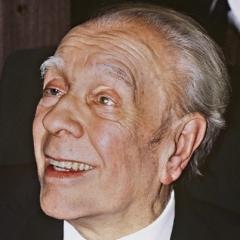
Jorge Luis Borges
Jorge Luis Borges

Jorge Luis Borges was an Argentine writer, poet, and literary critic. His works are known for their unique fantasy and philosophical thinking, which have had a profound impact on 20th-century literature. more

You May Also Like

“This connection of all created things with every single one of them and their adaptation to every single one, as well as the connection and adaptation of every single thing to all others, has the result that every single substance stands in relations which express all the others. Whence every single substance is a perpetual living mirror of the universe.”

“4.19. Dedekind's approach is a singular combination of Descartes' Cogito and the idea of the idea in Spinoza. The starting point is the very space of the Cogito, as 'closed' configuration of all possible thoughts, existential point of pure thought. It is claimed (but only the Cogito assures us of this) that something like the set of all my possible thoughts exists. From Spinoza's causal 'serialism' (regardless of whether or not he figured in Dedekind's historical sources) are taken both the existence of a parallelism' which allows us to identify simple ideas by way of their object (Spinoza says: through the body of which the idea is an idea), and the existence of a reflexive redoubling, which secures the existence of 'complex' ideas, whose object is no longer a body, but another idea. For Spinoza, as for Dedekind, this process of reflexive redoubling must go to infinity. An idea of an idea (or the thought of a thought of an object) is an idea. So there exists an idea of the idea of a body, and so on.”

“The electoral victories of Thatcher (1979) and Reagan (1980) are often viewed as a distinctive rupture in the politics of the postwar period. I understand them more as consolidations of what was already under way throughout much of the 1970s. The crisis of 1973-5 was in part born out of a confrontation with the accumulated rigidities of government policies and practices built up during the Fordist-Keynesian period. Keynesian policies had appeared inflationary as entitlements grew and fiscal capacities stagnated. Since it had always been part of the Fordist political consensus that redistributions should be funded out of growth, slackening growth inevitably meant trouble for the welfare state and the social wage.”