Quotessence
Home / Quotes / Quote by Homer

Quote by Homer

“We men are wretched things, and the gods, who have no cares themselves, have woven sorrow into the very pattern of our lives...Zeus the Thunderer has two jars standing on the floor of his palace, in which he keeps his gifts, the evils in one and the blessings in the other.”

Quote by Homer

Work

The Iliad

An ancient Greek epic, The Iliad, narrates the events of the Trojan War, focusing on the conflict between the Greeks and the Trojans, particularly the story of the warrior Achilles. more

Author

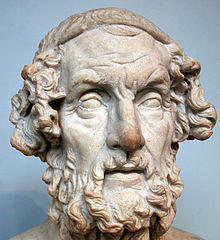
Homer
Homer

Homer, according to limited information, was an ancient Greek poet, credited with authorship of the epic poems 'The Iliad' and 'The Odyssey'. His biography is not well-documented, with the exact dates of his birth and death unknown. His works have had a profound impact on Western literature. more

You May Also Like

“Are you finally admitting that you can sell a man hope? Have I at last succeeded in teaching you that?” He laughed and flicked his whip again, harder. He was in a better mood than I had seen for months. “No, Camelot, not hope. Hope is for the weak; have I not succeeded in teaching you that? To hope is to put your faith in others and in things outside yourself; that way lies betrayal and disappointment. They didn't want hope, Camelot; they wanted certainty. What a man needs is the certainty that he is right, no self-doubt, no fleeting thought that he might be wrong or misled. Absolute certainty that he is right—that's what gives a man the confidence and power to do whatever he wants and to take whatever he wants from this world and the next.”

“Although there are certain needs, such as hunger, thirst, sex, which are common to man, those drives which make for the differences in men's characters, like love and hatred, the lust for power and the yearning for submission, the enjoyment of sensuous pleasure and the fear of it, are all products of the social process. The most beautiful as well as the most ugly inclinations of man are not part of a fixed and biologically given human nature, but result from the social process which creates man. In other words, society has not only a suppressing function - although it has that too - but it has also a creative function.”

“Actually, what does man live for?” “To think about it. Any other question?” “Yes. Why does he die just when he has done that and has become a bit more sensible?” “Some people die without having become more sensible.” “Don’t evade my question. And don’t start talking about the transmigration of souls.” “I’ll ask you something else first. Lions kill antelopes; spiders flies; foxes chickens; which is the only race in the world that wars on itself uninterruptedly, fighting and killing one another?” “Those are questions for children. The crown of creation, of course, the human being— who invented the words love, kindness, and mercy.” “Good. And who is the only being in Nature that is capable of committing suicide and does it?” “Again the human being— who invented eternity, God, and resurrection.” “Excellent,” Ravic said. “You see of how many contradictions we consist. And you want to know why we die?”

“Freedom and wildness, that which we were born into, is a grand mystery and miracle that creates a openness reserved not for barring us in but for keeping us out of cages. It is our ability to find the truth that has been a survival tool for our species both individually and corporately.”