Quotessence
Home / Quotes / Quote by Arthur Conan Doyle

Quote by Arthur Conan Doyle

Work

Collected Works of Sir Arthur Conan Doyle (Delphi Classics)

The Collected Works of Sir Arthur Conan Doyle (Delphi Classics) is a comprehensive compilation of the author's literary output. It encompasses the iconic Sherlock Holmes detective stories, which have captivated readers for over a century, as well as a variety of other works, including historical novels, science fiction, and non-fiction. This collection is a testament to Doyle's versatility as a writer and his enduring influence on the genre of detective fiction. more

Author
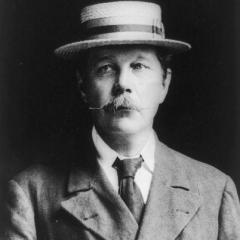
Arthur Conan Doyle
Arthur Conan Doyle

Arthur Conan Doyle, born on May 22, 1859 in Edinburgh, Scotland, was a renowned Scottish physician and writer. He is best known for his creation of the Sherlock Holmes series of detective novels, which have had a profound impact on the development of detective fiction and played a crucial role in shaping modern detective culture. more

You May Also Like

“Academic environments are generally characterised by the presence of peole who claim to understand more than in fact they do. Linguistic Philosophy has produced a great revolution, generating people who claim not to understand when in fact they do. Some achieve great virtuosity at it. Any beginner in philosophy can manage not to understand, say, Hegel, but I have heard people who were so advanced that they knew how not to understand writers of such limpid clarity as Bertrand Russell or A.J. Ayer.”

“Luckily, I remembered something Malcolm Cowley had taught us at Stanford - perhaps the most important lesson a writing class (not a writer, understand, but a class) can ever learn. 'Be gentle with one another's efforts,' he often admonished us. 'Be kind and considerate with your criticism. Always remember that it's just as hard to write a bad book as it is to write a good book.'”

“For thirty years most interface design, and most comptuer design, has been headed down the path of the "dramatic" machine. Its highest idea is to make a computer so exciting, so wonderful, so interesting, that we never want to be without it. A less-traveled path I call the "invisible"; its highest idea is to make a computer so imbedded, so fitting, so natural, that we use it without even thinking about it.”