Quotessence
Home / Quotes / Quote by James Madison

Quote by James Madison

“And may I not be allowed to ... read in the character of the American people, in their devotion to true liberty and to the Constitution which is its palladium [protection], ... a Government which watches over ... the equal interdict [prohibition] against encroachments and compacts between religion and the state.”

Quote by James Madison

Author
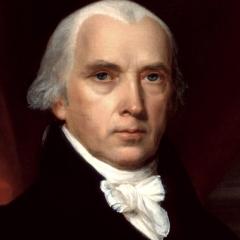
James Madison
James Madison

James Madison, the 4th President of the United States, was born on March 16, 1751, and died on June 28, 1836. He was a key figure in drafting the U.S. Constitution and had a profound impact on the political system of the United States. more

You May Also Like

“I have received your letter of the 6th, with the eloquent discourse delivered at the consecration of the Jewish Synagogue. Having ever regarded the freedom of religious opinions and worship as equally belonging to every sect, and the secure enjoyment of it as the best human provision for bringing all either into the same way of thinking, or into that mutual charity which is the only substitute, I observe with pleasure the view you give of the spirit in which your sect partake of the blessings offered by our Government and laws.”

“The notion that science does not concern itself with first causes - that it leaves the field to theology or metaphysics, and confines itself to mere effects - this notion has no support in the plain facts. If it could, science would explain the origin of life on earth at once - and there is every reason to believe that it will do so on some not too remote tomorrow. To argue that gaps in knowledge which will confront the seeker must be filled, not by patient inquiry, but by intuition or revelation, is simply to give ignorance a gratuitous and preposterous dignity.”

“Here the only genuine conflict is between true believers. Of a given text in Holy Writ one faction may say this thing and another that, but both agree unreservedly that the text itself is impeccable, and neither in the midst of the most violent disputation would venture to accuse the other of doubt. To call a man a doubter in these parts is equal to accusing him of cannibalism. Even the infidel Scopes himself is not charged with any such infamy.”