“But, sceptic that he was, he had one fanatical devotion, not for an idea, a creed, an art or a science, but for a man — for Enjolras. Grantaire admired, loved, and venerated Enjolras. The anarchic questioner of all beliefs had attached himself to the most absolute of all that circle of believers. Enjolras had conquered him not by any force of reason but by character. It is a not uncommon phenomenon. The sceptic clinging to a believer is something as elementary as the law of complementary colours. We are drawn to what we lack. No one loves daylight more than a blind man. The dwarf adores the drum-major. The toad has its eyes upturned to Heaven, and for what? — to watch the flight of the birds. Grantaire, earthbound in doubt, loved to watch Enjolras soaring in the upper air of faith. He needed Enjolras. Without being fully aware of it, or seeking to account for it himself, he was charmed by that chaste, upright, inflexible, and candid nature. Instinctively he was attracted to his opposite. His flabby, incoherent, and shapeless thinking attached itself to Enjolras as to a spinal column. He was in any case a compound of apparently incompatible elements, at once ironical and friendly, affectionate beneath his seeming indifference. His mind could do without faith, but his heart could not do without friendship: a profound contradiction, for affection in itself is faith. Such was his nature. There are men who seem born to be two-sided. They are Pollux, Patrocles, Nisus, Ephestion. They can live only in union with the other who is their reverse side; their name is one of a pair, always preceded by the conjunction "and"; their lives are not their own; they are the other side of a destiny which is not theirs. Grantaire was one of those, the reverse side of Enjolras. Truly the satellite of Enjolras, he formed one of that circle of young men, went everywhere with them and was only happy in their company. His delight was to see those figures moving amid the mists of wine, and they bore with him because of his good humour. Enjolras, the believer, despised the sceptic and soberly deplored the drunkard. His attitude towards him was one of pitying disdain. Grantaire was an unwelcome Ephestion. But, roughly treated though he was by Enjolras, harshly repulsed and rejected, he always came back, saying of him: "What a splendid statue!”
Quote by Victor Hugo
Work
Victor Hugo's 'Les Misérables' is an epic narrative that delves into the lives of various characters, including Jean Valjean, a former convict seeking redemption, and Fantine, a woman struggling in poverty. The story is rich in historical detail and moral complexity, offering a profound examination of society's flaws and the resilience of the human spirit. more
Author
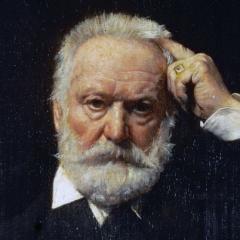
Victor Hugo, a French romantic poet, novelist, and playwright, was born on February 26, 1802, and died on May 22, 1885. He is considered one of the greatest writers in French literary history, known for his profound humanistic concerns and rich imagination. more
You May Also Like
“Falling in love should be the easiest thing in the world, but it's not.”
“Supposedly, dreams reflect our hidden fears and secret desires, all clamoring for attention.”
“Lindsey: Why would you choose me? Rafe: Because you're the one I want.”