Quotessence
Home / Quotes / Quote by Friedrich Nietzsche

Quote by Friedrich Nietzsche

“What is good? All that enhances the feeling of power, the Will to Power, and power itself in man. What is bad? — All that proceeds from weakness. What is happiness? — The feeling that power is increasing — that resistance has been overcome.”

Quote by Friedrich Nietzsche

Author
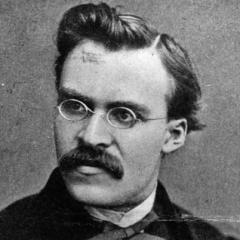
Friedrich Nietzsche
Friedrich Nietzsche

Friedrich Nietzsche was a German philosopher, cultural critic, poet, and writer whose works have had a profound impact on subsequent philosophy, literature, and thought. His ideas revolve around concepts such as the 'will to power', the 'Übermensch', and the 'eternal recurrence'. more

You May Also Like

“I am interested only in the relations of a people to the rearing of the individual man, and among the Greeks the conditions were unusually favourable for the development of the individual; not by any means owing to the goodness of the people, but because of the struggles of their evil instincts.With the help of favourable measures great individuals might be reared who would be both different from and higher than those who heretofore have owed their existence to mere chance. Here we may still be hopeful: in the rearing of exceptional men.”

“Every man has his price. This is not true. But for every man there exists a bait which he cannot resist swallowing. To win over certain people to something, it is only necessary to give it a gloss of love of humanity, nobility, gentleness, self-sacrifice - and there is nothing you cannot get them to swallow. To their souls, these are the icing, the tidbit; other kinds of souls have others.”

“As regards the celebrated struggle for life, it seems to me for the present to have been rather asserted than proved. It does occur, but as the exception; the general aspect of life is not hunger and distress, but rather wealth, luxury, even absurd prodigality -- where there is a struggle it is a struggle for power.”

“A belief, however necessary it may be for the preservation of a species, has nothing to do with truth. The falseness of a judgment is not for us necessarily an objection to a judgment. The question is to what extent it is life-promoting, life-preserving, species preserving, perhaps even species cultivating. To recognize untruth as a condition of life--that certainly means resisting accustomed value feelings in a dangerous way; and a philosophy that risks this would by that token alone place itself beyond good and evil.”

“Have you heard of that madman who lit a lantern in the bright morning hours, ran to the market place, and cried incessantly, I seek God! I seek God! As many of those who do not believe in God were standing around just then, he provoked much laughter... Whither is God, he cried. I shall tell you. We have killed him - you and I. All of us are murderers.... God is dead. God remains dead. And we have killed him.”