Quotessence
Home / Quotes / Quote by Yukio Mishima

Quote by Yukio Mishima

“He was in a room of the Gesshuuji, which he had thought it would be impossible to visit. The approach of death had made the visit easy, had unloosed the weight that held him in the depths of being. It was even a comfort to think, from the light repose the struggle up the hill had brought him, that Kiyoaki, struggling against illness up that same road, had been given wings to soar with by the denial that awaited him.”

Quote by Yukio Mishima

Author
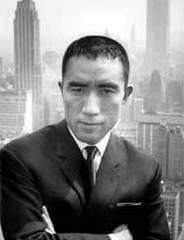
Yukio Mishima
Yukio Mishima

Yukio Mishima was a Japanese author and playwright, a prominent figure in post-war Japanese literature. His works, characterized by a fusion of traditional Japanese aesthetics and modernist techniques, often explored themes of tradition, ritual, and the samurai code. more

You May Also Like

“The Chinese believe that before you can conquer a beast you first must make it beautiful. In some strange way, I have tried to do that with manic-depressive illness. It has been a fascinating, albeit deadly, enemy and companion; I have found it to be seductively complicated, a distillation both of what is finest in our natures, and of what is most dangerous.”

“"No," he says, taking us both in. "No, no, no. You've come farther than most people on this planet will in their lifetimes. You've overcome obstacles and dangers and things that should've killed you. You've outrun an army and a madman and deadly illness and seen things most people will never see. How do you think you could have possibly come this far if you didn't have hope?"”

“In the long term, a robust health IT network will support personalized treatment that adheres to proven best practices, and adapts to your personal health circumstances. The time will come when, whatever illness you may have, for your body type and health history, there will 'be an app for that' to keep you on your best path to wellness.”

“The measure of (mental) health is flexibility (not comparison to some 'norm'), the freedom to learn from experience ... to be influenced by reasonable arguments ... and the appeal to the emotions ... and especially the freedom to cease when sated. The essence of illness is the freezing of behavior into unalterable and insatiable patterns.”