Quotessence
Home / Quotes / Quote by Plato

Quote by Plato

“Socrates: I'm afraid that it might actually be sacrilegious to stand idly by while morality is being denigrated and not try to assist as long as one has breath in one's body and a voice to protest with.”

Quote by Plato

Work

The Republic

In 'The Republic,' Plato presents a dialogue between Socrates, Glaucon, and other philosophers, discussing the nature of justice, the structure of an ideal society, and the role of philosophers as rulers. The work is divided into ten books and delves into various philosophical topics, including the nature of the soul, the nature of justice, and the nature of the state. more
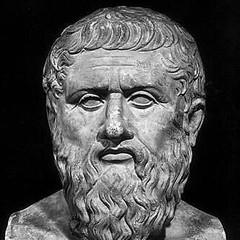
Author

Plato
Plato

Plato (428 BC - 348 BC) was a prominent Greek philosopher, one of the most influential figures in Western philosophy. He founded the Academy, which was the first institution of higher education in the Western world. Plato's philosophy, centered around the theory of Forms, emphasized the importance of reason and morality. more

You May Also Like

“In the "Republic," Plato vigorously attacked the oral, poetized form as a vehicle for communicating knowledge. He pleaded for a more precise method of communication and classification ("The Ideas"), one which would favor the investigation of facts, principles of reality, human nature, and conduct. What the Greeks meant by "poetry" was radically different from what we mean by poetry. Their "poetic" expression was a product of a collective psyche and mind. The mimetic form, a technique that exploited rhythm, meter and music, achieved the desired psychological response in the listener. Listeners could memorize with greater ease what was sung than what was said. Plato attacked this method because it discouraged disputation and argument. It was in his opinion the chief obstacle to abstract, speculative reasoning - he called it "a poison, and an enemy of the people.”

“It was just as the 1914 War burst on me that I made the discovery that "legends" depend on the language to which they belong; but a living language depends equally on the "legends" which it conveys by tradition. (For example, that the Greek mythology depends far more on the marvellous aesthetic of its language and so of its nomenclature of persons and places and less on its content than people realize, though of course it depends on both. And vice versa. Volapuk, Esperanto, Ido, Novial, &C. are dead, for deader than ancient unused languages, because their authors never invented any Esperanto legends.). (letter 180)”