“The characteristic feature of militarism is not the fact that a nation has a powerful army or navy. It is the paramount role assigned to the army within the political structure. Even in peacetime the army is supreme; it is the predominant factor in political life. The subjects must obey the government as soldiers must obey their superiors. Within a militarist community there is no freedom; there are only obedience and discipline.”
Quote by Ludwig von Mises
Work
Omnipotent Government: The Rise of the Total State and Total War
This book delves into the historical and philosophical underpinnings of omnipotent government, exploring the emergence of the total state and its role in total war. It analyzes the political, social, and economic factors that contribute to the rise of such regimes and their impact on international relations. more
Author
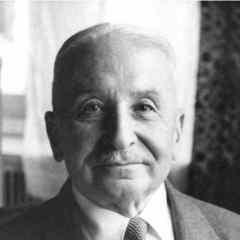
Ludwig von Mises
Ludwig von Mises was a prominent economist, philosopher, and social theorist born on September 29, 1881, in Austria, and passed away on October 10, 1973. He is considered one of the most influential economists of the 20th century and a leading advocate for free-market economics. more
You May Also Like
“Human action is purposeful behavior.”
Source: Human Action
Source: The free and prosperous commonwealth: an exposition of the ideas of classical liberalism
“Well, I could do it for a day, but I wouldn't want to be a teenager again. I really wouldn't.”
Source: The Ultimate Foundation of Economic Science: An Essay on Method
Source: Anti-Capitalistic Mentality, The
Source: Human Action
Source: Anti-Capitalistic Mentality, The
“Reason is the main resource of man in his struggle for survival.”
Source: Omnipotent Government: The Rise of the Total State and Total War