Quotessence
Home / Quotes / Quote by Earl Warren

Quote by Earl Warren

“[O]ur War of the Revolution was, in good measure, fought as a protest against standing armies.”

Quote by Earl Warren

Author
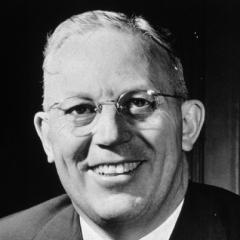
Earl Warren
Earl Warren

Earl Warren served as the 14th Chief Justice of the United States from 1953 to 1969, known for his progressive judicial philosophy and landmark decisions that expanded civil rights and liberties. more

You May Also Like

“The abhorrence of society to the use of involuntary confessions does not turn alone on their inherent untrustworthiness. It also turns on the deep-rooted feeling that the police must obey the law while enforcing the law; that, in the end, life and liberty can be as much endangered from illegal methods used to convict those thought to be criminals as from the actual criminals themselves.”

“Thus, if there exists a law which sanctions slavery or monopoly, oppression or robbery, in any form whatever, it must not even be mentioned. For how can it be mentioned without damaging the respect which it inspires? Still further, morality and political economy must be taught from the point of view of this law; from the supposition that it must be a just law merely because it is a law. Another effect of this tragic perversion of the law is that it gives an exaggerated importance to political passions and conflicts, and to politics in general.”

“All you have to do, is to see whether the law takes from some what belongs to them in order to give it to others to whom it does not belong. We must see whether the law performs, for the profit of one citizen and to the detriment of others, an act which that citizen could not perform himself without being guilty of a crime. Repeal such a law without delay. ... [I]f you don't take care, what begins by being an exception tends to become general, to multiply itself, and to develop into a veritable system.”

“What our view of the effectiveness of religion in history does at once make evident as to its nature is--first, its necessary distinction; second, its necessary supremacy. These characters though external have been so essential to its fruitfulness, as to justify the statement that without them religion is not religion. A merged religion and a negligible or subordinate religion are no religion.”

“We are driven to confess that we actually care more for religion than we do for religious theories and ideas: and in merely making that distinction between religion and its doctrine-elements, have we not already relegated the latter to an external and subordinate position? Have we not asserted that "religion itself" has some other essence or constitution than mere idea or thought?”

“However rich we may become in knowledge of the deeper causes of historical results, we forgo all understanding of history if we forget this inner continuity,--i.e., the conscious intentions of the participants in history-making and their consciously known successes.”